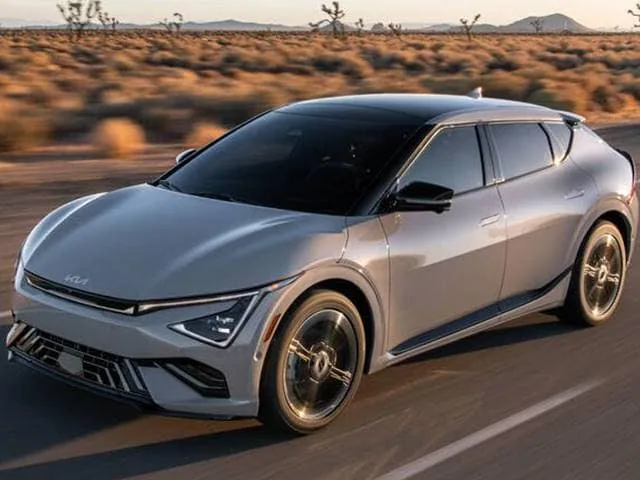
2026 Kia EV6 AWD GT
Electric SUV · AWD
Based on battery health, build quality, owner data, EPA range, and market pricing
Below average for 2026 EV Compact SUVs (class avg 68)
Personalize this scoreIs a low score bad?
Last scanned 12 days ago
The 2026 Kia EV6 AWD GT is rated at 601 hp, 231 miles of EPA range and a 74 kWh battery, and a mid-pack composite means the records-and-test-drive call matters more than the headline.
Score read
A 66/100 makes this worth comparing, not chasing. Build quality score is 86/100, but range and efficiency score is only 37/100. Reddit threads cluster around software tech and owner satisfaction — verify both against the service records. Next, prove battery condition, charging behavior, tires, and service history.
Price context
Used examples are running around $44,375. Treat that as a budgeting floor, not a final price; pull a current KBB Fair Purchase or Edmunds True Market Value for this exact trim before negotiating.
Who this is for
✓ Good for
- ⏱ Daily commuter ≤50 mi/day, predictable charging
✗ Avoid if you are a
- $ Bargain hunter Best TCO, reliability + low depreciation
Gotchas
- Built in Range is the easy place to overbuy this trim (37/100).
Mitigation Check your commute, winter margin, and fast-charge plan before you assume the EPA number fits your use.
Pre-purchase inspection
- 1 Compare the dashboard range estimate with the EPA 231-mile rating after a full charge.
- 2 Confirm how much of the 10-year/100,000-mile battery warranty remains and whether it transfers.
- 3 If road trips matter, run a short DC fast-charge session and watch whether speed tapers normally.
- 4 Map your normal highway route and winter margin against the EPA range before you treat it as a road-trip car.
- 5 Review title, service history, tire condition, and charging-equipment records before final price.
No recall records in this scan That helps the shortlist, but it does not replace a VIN lookup, battery report, and service-history check.
Complaint context This scan found 0 NHTSA complaint records (0 per 10K VINs, low for any vehicle class). Read the themes below before treating the raw count as the verdict.
Price needs outside confirmation Current market pricing is incomplete, so MSRP should not be used as the deal signal. Compare KBB, J.D. Power, and live listings for this exact trim.
Pricing & Market Value
Score Breakdown
What matters most to you?
Drag the sliders to prioritize what you care about. Your TrimIndex Score recalculates instantly.
Vehicle Specifications
The federal $4,000 used-EV credit ended Sept 30, 2025.
But 10 states still run their own used-EV rebate programs — some up to $5,000. Pick your state to see what's available for this trim.
Source & disclaimer
Dealers make ~$3,575 on the average car loan.
After the price is set, the finance manager runs four plays to rebuild margin. Every buyer without a pre-approval is a target. Here's exactly what they run — and what stops each one.
78% of dealer loans carry a hidden +1.13% markup above what the lender actually charges. You never see it — it's buried in the contract. · CFPB
Dealer must match or beat your lender — they can't add margin invisibly. The markup play is dead on arrival.
Once you answer, they stretch the term to hit your number. Median result: $4K less off the price, 12 more months on the loan. · Industry avg
Financing is done. Only the sale price is on the table — and the dealer knows it.
Back-office F&I profit averages $1,975/vehicle, up 8.5% YoY. These products exist — but dealer markup is 4–10x what you'd pay elsewhere. · Dealership Guy
Dealer GAP runs $500–1K. Your insurer sells the same coverage for $100–250 over 5 years. Now you know.
"Your loan fell through — come re-sign." This pulls your APR up +5% on average. It's legal. It works because you've already driven the car home. · Ctr for Responsible Lending
A lender commitment letter means the deal is final. "Pending dealer approval" doesn't apply. You can't be yo-yo'd.
Margin handed to the dealer's finance department — for nothing.
Takes 2 minutes. No obligation to use it — but you'll walk in with all the leverage.
Pre-approval is a soft credit inquiry — no score impact. FICO treats all auto-loan hard pulls within 14 days as one, so you can still shop rates at the dealer.
NHTSA Recalls (0)
NHTSA Complaints (0 total · 0 per 10K US vehicles · low for any vehicle class)
No complaints filed with NHTSA for this vehicle.
What Owners Are Saying
"lol at the snobs in this thread. I’m coming out of my EV6 lease as well. I LOVE the I4- but with two kids and frequent drives to visit family, it is unfortunate too small for us. I’ll be looking at an IX tomorrow. I agree with you on a lot of your pros and cons. My EV6 has been fantastic, but I’m looking forward to the fit and finish of a BMW once more. Thanks for the thorough comparison- this will be very helpful for many people deciding between the EV6 and i4."
"I love my EV6, and it's fit w lot of what I wanted in a car. With the seats down, I could imagine sleeping in the back and the V2L is a nice addon. I was an unfortunate victim of the iccu issue, though for me, it was replaced and fixed within 10 days I think. My lease is up in October and I'm still thinking of staying with it for my next car."
"Let’s hunt down ICCU failures by crowdsourcing OBD data I recently became a Kia EV6 owner. I love E-GMP cars. It sucks that they come with the caveat of ICCU failure risk and that HMG hasn’t fixed it. In our discourse, we have come up with many theories. But our supporting evidence has been limited to personal experience, local stats from a dealership, and forum polls where victims are overrepresented. These kinds of anecdotal evidence lack statistical power. What if, instead of saying: * Both the condensation theory and the cold weather theory are wrong because my ICCU LDC popped in hot dry Arizona * MY2025s are just as likely to fail as MY2022-2024s because my MY2025 failed after 1000 miles We could say: * There is support for the condensation theory because there is a moderate (*n*=500, *r*=0.5) correlation between interior relative humidity and failure incidence (see histogram) * When controlled for mileage, we see an insignificantly lower (*p*=0.3) rate of failure among MY2025+ compared to MY2022-2024 * We know exactly how the ICCU cooling logic changed in the latest OTA software update, and we can detect anomalous behavior from OBD data * We trained a machine learning model that predicts ICCU LDC failures at the beginning of each trip with 75% accuracy given fine-grained OBD data over the past 6 months This is the vision of iccu.observer, where E-GMP drivers can upload recorded OBD data from all their trips and charging sessions into an open dataset. This is similar in spirit to Route Loser’s community SoH tracker and chris\_11's defect statistics. I hope to build a minimal first version of the platform soon, but in the meantime, I don’t want to miss any ICCU failures, so here is an off-the-shelf minimal viable product. Because anyone driving their E-GMP car could be the next victim, everyone is invited to contribute. To contribute, you need to have an E-GMP vehicle and the ability to read OBD parameters using the Car Scanner ELM app. **Visit** [**how.iccu.observer**]("
"My Kia EV6 (2021-2024) was stolen via “GameBoy” gadget — what can owners do? Hi everyone, I’m posting here because my EV6 (year 2022) was stolen recently, and the circumstances look like the more to GAMEBOY theft method that’s being reported widely for Kia/Hyundai group EVs. I’ve already contacted Kia Europe, my local dealer, and a well-known EV YouTuber, but I haven’t seen a meaningful response yet from Kia about any broad recall/patch or clear guidance. I wanted to raise awareness and see if any owners here know more about what Kia is doing (or plans to do) — and what we, as a community, are doing to protect ourselves. **Questions I’d like fellow owners to help answer:** 1. Has anyone here (EV6 owner) knows if Kia plans some *software or hardware security update/recall/notice* specifically for this vulnerability? 2. Do you know if the newer model(s) (EV3, EV4 or EV6 refresh) have improved security / different keyless entry protocol / better immobiliser / or have Kia explicitly said so? 3. What additional protection measures are you using and how effective do you feel they are? 4. Have you raised this with the dealer or Kia and did they respond with anything concrete?"
"Charge Port Overheating — Findings and Analysis This post continues my previous ones: * Initial fix attempt * Data and discussion Thanks to u/KennyBS167 for the engagement-depth idea and @theotherharper for helping analyze it through Ohm’s law. # The Issue My charge port overheats and stops charging at the maximum rate (11.2 kW). I don’t have the SC311 that throttles based on inlet temperature. The vehicle measures inlet temperature via a thermistor placed directly on the crimped pin inside the charge port (see pics). The official SAE J1772 conductive charging standard (available here, PDF) sets a maximum temperature rise of 50 °C at rated current. Kia’s thermal cutoff occurs at roughly 200 °F / 93 °C. In theory, that means charging at full rate should be safe even with ambient temperatures well over 100 °F (38 °C). In practice, it’s not — and this may help explain why NACS (Tesla’s connector) has overtaken J1772. # Measurements and Method The J1772 drawings show that the distance from the charge-port face to the pin head can vary from 5.5 mm to 7.5 mm (0.216–0.295 in). That’s a big allowable range for something carrying 40–48 A. My early measurements used a tread gauge with 9/32 in marks (not precise enough). I now use a digital depth gauge. I ran multiple charging sessions from 6 A → 48 A @ 240 V, each lasting several hours, plus an L1 120 V @ 15 A test. Temperature rise was logged via Carscanner. # What I Found 1. Even tiny changes in pin-socket engagement depth (a few thousandths of an inch) had a measurable impact on connector temperature. 2. The temperature rise scaled cleanly with Ohm’s Law (P=I2RP = I\^2RP=I2R): * Higher current → higher heat in proportion to I2I\^2I2. * No sudden spikes, which means no arcing — just resistive heating. 3. Increasing pin engagement depth reduced apparent resistance (R) and thus the heat generated. In one 48 A test, I left the orange port shroud un-ziptied and wiggled/pushed the wires in by hand and observed a temp drop. 4. All tests above \~30 A exceeded the 50 °C rise limit from SAE J1772, though they stayed below Kia’s 93 °C thermal throttle. # Example Results * **Before pin adjustment:** Pin depth ≈ 6.93 mm, ΔT ≈ 90 °C at 48 A. * **After fine adjustment:** Pin depth ≈ 6.8 mm, ΔT ≈ 59 °C at 48 A. That’s still slightly out of spec but a significant improvement. My L1 (120 V @ 15 A) test also showed a higher apparent resistance because that cable’s female sockets has shallower pin engagement. # Interpretation The pin/socket joint behaves as a resistor. Even a small change in how"
"#2· Feb 9, 2026 Yes, same to me. All the setting were returned to factory default and required reconfiguring. #3· Feb 9, 2026 #4· Feb 9, 2026 And I also noticed it when the car did not stop on a traffic light but continued rolling as my i-pedal appeared deactivated. #5· Feb 9, 2026 I am not sure how many other system updates I have had. I did get a message the other day to say that my two free OTA updates had finished. Not sure if that is only related to the map updates though. First time I have had any updates reset the drive settings and I agree with @Ed Cy that this is actually dangerous. Kia really should provide a warning to the effect that settings have been reset as part of the update. Would not be difficult to implement I think."
Showing 6 of 14 owner excerpts (sorted by sentiment strength)