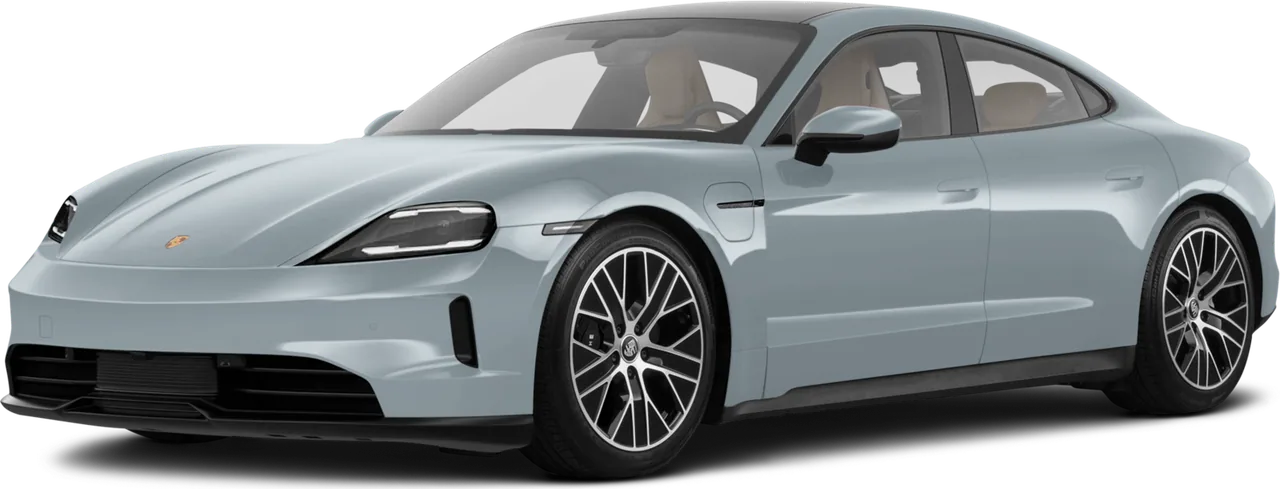
2026 Porsche Taycan Turbo GT with Weissach Package
Electric Hatchback · AWD
Based on battery health, build quality, owner data, EPA range, and market pricing
Above average for 2026 EV Hatchbacks (class avg 65 · top 14%)
Personalize this scoreIs a low score bad?
Last scanned 22 days ago
The 2026 Porsche Taycan Turbo GT with Weissach Package packs 269 miles of EPA range, 320 kW fast charging and a 97 kWh battery, and a worth-pursuing score, but only after a hard inspection and a fair price.
Score read
A 71/100 makes this a records-first inspection. Do not let the composite hide this split: build quality score is 100/100, while range and efficiency score is 37/100. Owner satisfaction is the recurring theme in Reddit owner posts; treat it as an inspection item, not a footnote. The remaining risk is ordinary used-car diligence: battery report, tires, title, and records.
Price context
This trim started from $243,700 new. Used examples have come down since launch, but pricing varies by miles, condition, and how the model is moving right now; pull a current KBB Fair Purchase, an Edmunds True Market Value, or an active dealer listing for this exact trim, and anchor your offer there. Walk if the seller will not move off new-car-style pricing.
Who this is for
✓ Good for
- ⏱ Daily commuter ≤50 mi/day, predictable charging
✗ Avoid if you are a
- $ Bargain hunter Best TCO, reliability + low depreciation
Gotchas
- Built in Range is the easy place to overbuy this trim (37/100).
Mitigation Check your commute, winter margin, and fast-charge plan before you assume the EPA number fits your use.
- Verify Current market pricing is not confirmed well enough for this trim.
Mitigation Compare KBB, J.D. Power, and live listings for the same trim before treating price as a buying signal.
Pre-purchase inspection
- 1 Compare the dashboard range estimate with the EPA 269-mile rating after a full charge.
- 2 Confirm how much of the 8-year/100,000-mile battery warranty remains and whether it transfers.
- 3 If road trips matter, run a short DC fast-charge session and watch whether speed tapers normally.
- 4 Map your normal highway route and winter margin against the EPA range before you treat it as a road-trip car.
- 5 Review title, service history, tire condition, and charging-equipment records before final price.
No recall records in this scan That helps the shortlist, but it does not replace a VIN lookup, battery report, and service-history check.
Complaint context This scan found 0 NHTSA complaint records (0 per 10K VINs, low for any vehicle class). Read the themes below before treating the raw count as the verdict.
Price needs outside confirmation Current market pricing is incomplete, so MSRP should not be used as the deal signal. Compare KBB, J.D. Power, and live listings for this exact trim.
Pricing & Market Value
Score Breakdown
What matters most to you?
Drag the sliders to prioritize what you care about. Your TrimIndex Score recalculates instantly.
Vehicle Specifications
The federal $4,000 used-EV credit ended Sept 30, 2025.
But 10 states still run their own used-EV rebate programs — some up to $5,000. Pick your state to see what's available for this trim.
Source & disclaimer
Dealers make ~$3,575 on the average car loan.
After the price is set, the finance manager runs four plays to rebuild margin. Every buyer without a pre-approval is a target. Here's exactly what they run — and what stops each one.
78% of dealer loans carry a hidden +1.13% markup above what the lender actually charges. You never see it — it's buried in the contract. · CFPB
Dealer must match or beat your lender — they can't add margin invisibly. The markup play is dead on arrival.
Once you answer, they stretch the term to hit your number. Median result: $4K less off the price, 12 more months on the loan. · Industry avg
Financing is done. Only the sale price is on the table — and the dealer knows it.
Back-office F&I profit averages $1,975/vehicle, up 8.5% YoY. These products exist — but dealer markup is 4–10x what you'd pay elsewhere. · Dealership Guy
Dealer GAP runs $500–1K. Your insurer sells the same coverage for $100–250 over 5 years. Now you know.
"Your loan fell through — come re-sign." This pulls your APR up +5% on average. It's legal. It works because you've already driven the car home. · Ctr for Responsible Lending
A lender commitment letter means the deal is final. "Pending dealer approval" doesn't apply. You can't be yo-yo'd.
Margin handed to the dealer's finance department — for nothing.
Takes 2 minutes. No obligation to use it — but you'll walk in with all the leverage.
Pre-approval is a soft credit inquiry — no score impact. FICO treats all auto-loan hard pulls within 14 days as one, so you can still shop rates at the dealer.
NHTSA Recalls (0)
NHTSA Complaints (0 total · 0 per 10K US vehicles · low for any vehicle class)
No complaints filed with NHTSA for this vehicle.
What Owners Are Saying
"From personal experience after test drives, and getting a 4S. 1. Get the bigger battery (Perfomance Battery Plus) 2. Sport chrono - the difference between Sport in regular cars and Sport+ with Sport Chrono is massive 3. Rear wheel steering - combined with Sport Chrono makes the car a proper sports car. I have taken a some people on spirited drives on twisty roads and even the ones with fast cars are shocked how fast the Taycan is around corners. And never skimp on tyres."
"On the verge of buying this Taycan 4S Sport Turismo - need opinions I’m honestly on the edge of pulling the trigger on this Taycan and wanted to ask the community before I do something financially irresponsible 😅 This is the one I’m looking at: It’s a 2022 Taycan 4S Sport Turismo with Porsche Approved warranty. I really like the Sport Turismo shape and practicality compared to the sedan. I’ve been testing a lot of EVs recently (Tesla Model 3, BYD Seal, CLA 250+ EQ) but this is the first one that actually makes me want this car. Before I go for it, I’d love to hear from owners: * anything I should watch out for with MY22 cars? * real world range? * any options you regret not getting? Would you buy a Taycan again? Trying to make a smart decision… but I’m very close to just saying “screw it” and buying it."
"I’ve done the research, don’t own. Have a Porsche, talk to the workshop all the time - 2025+ is the most reliable. However, if you’re looking for a used one, I’m aiming for 2023+. Workshop said they were seeing less issues, and also Porsche allows you to lease cars up to 5 years old. I like that option cause financing only makes sense if there’s gonna be equity for you to benefit from in the end. If you finance, you might owe money since they depreciate so much. Therefore, for me, 2020 is out of the question, plus the battery warranty would be up in 2 years - 4S has the best value. Definitely enough speed and it’s valuable to the most people so it depreciates the least. Turbo S id pretty cool, but depreciates the most, and there’s only 192 miles of range - not sure about must haves. I’ll let people who have the car decide, but the workshop gives me taycan loaners all the time, so I’d say improved battery (waiting to charge, finding chargers sucks) - owning Porsche right now, don’t skimp out on a low purchase price. The maintenance will destroy you. At the very least make sure it’s a CPO. Make sure the battery warranty will last you a few years. (That’s the longest, most expensive repair in the shop)"
"EV Salary Sacrifice Scheme for a Porsche Taycan I’m trying to wrap my head around EV salary sacrifice schemes (UK) specifically how they handle used cars and would really appreciate some real-world insight from anyone who’s been through this. I’ve been looking at a Porsche Taycan through a salary sacrifice scheme. The provider has sourced a used car (\~£70k market value), but the quote I’ve been given still appears to be structured as a “new vehicle lease” and based on the original P11D value (\~£115k). The monthly cost is therefore coming out very similar to what I’d expect for a brand new car, which doesn’t seem to reflect the fact the car has already taken a big depreciation hit. From what I can see: \- The agreement is labelled as “lease – new” \- BiK is clearly based on P11D (which I understand is correct) \- But it also looks like the lease pricing itself may be anchored to P11D rather than the actual acquisition cost of the used car So my questions are: 1) Is this normal for EV salary sacrifice schemes i.e. used cars still being priced as if they’re new from a lease perspective? 2) Are there providers that actually structure used EVs based on real purchase price/depreciation rather than just P11D? 3) Has anyone here successfully done salary sacrifice on a used EV where the monthly cost genuinely reflected the lower market value? 4) Or am I misunderstanding how the funding/lease model works entirely? For context: \- Higher rate taxpayer \- Looking at 48 months / 15k miles \- Comparing against just buying the car personally (which currently looks cheaper over the term) Would really appreciate any insight or experiences especially from anyone who’s gone down the used EV salary sacrifice route. Thanks in advance ."
Showing 4 of 6 owner excerpts (sorted by sentiment strength)