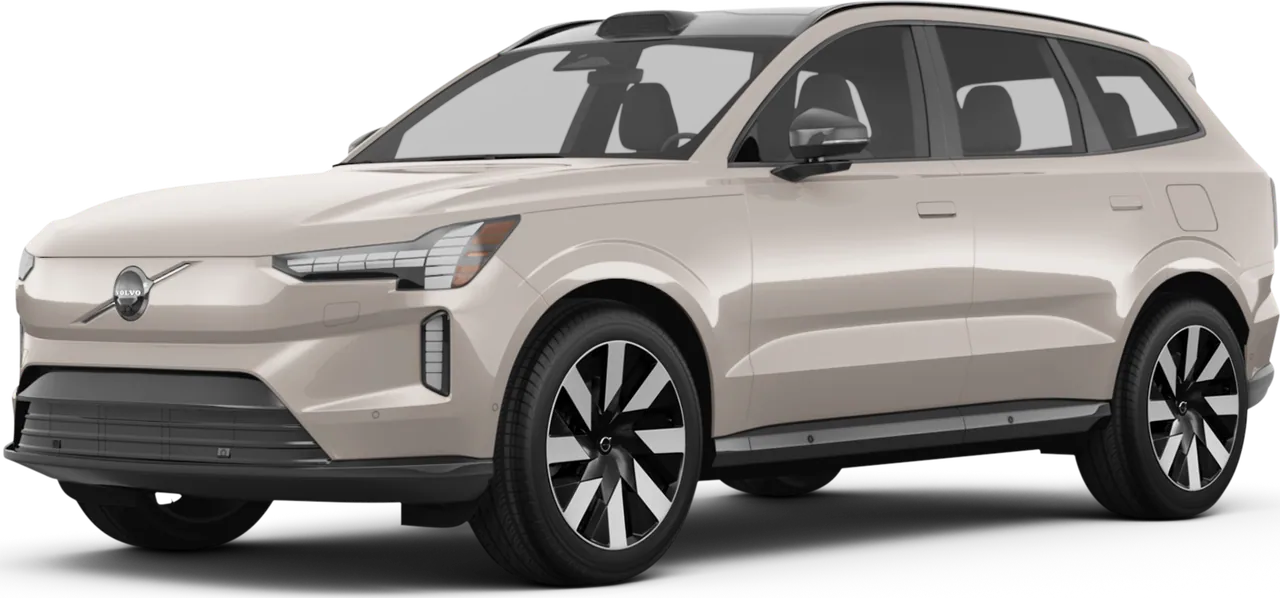
2026 Volvo EX90
21" wheels
Premium Electric SUV · RWD
Based on battery health, build quality, owner data, EPA range, and market pricing
Above average for 2026 EV SUVs (class avg 66 · top 30%)
Personalize this scoreIs a low score bad?
Last scanned 22 days ago
The 2026 Volvo EX90 (21-inch wheels) puts down 291 miles of EPA range, 250 kW fast charging and a 107 kWh battery, and a mid-pack composite means the records-and-test-drive call matters more than the headline.
Score read
A 69/100 makes this worth comparing, not chasing. Battery-health score is the cleaner read at 85/100; range and efficiency score needs more diligence at 43/100. Reddit threads cluster around owner satisfaction and software tech — verify both against the service records. Use the inspection to confirm the score is not hiding deferred maintenance.
Price context
This trim started from $76,695 new. Used examples have come down since launch, but pricing varies by miles, condition, and how the model is moving right now; pull a current KBB Fair Purchase, an Edmunds True Market Value, or an active dealer listing for this exact trim, and anchor your offer there. Walk if the seller will not move off new-car-style pricing.
Who this is for
✓ Good for
- ⏱ Daily commuter ≤50 mi/day, predictable charging
✗ Avoid if you are a
- $ Bargain hunter Best TCO, reliability + low depreciation
Gotchas
- Built in Range is the easy place to overbuy this trim (43/100).
Mitigation Check your commute, winter margin, and fast-charge plan before you assume the EPA number fits your use.
- Verify Current market pricing is not confirmed well enough for this trim.
Mitigation Compare KBB, J.D. Power, and live listings for the same trim before treating price as a buying signal.
Pre-purchase inspection
- 1 Compare the dashboard range estimate with the EPA 291-mile rating after a full charge.
- 2 Confirm how much of the 8-year/100,000-mile battery warranty remains and whether it transfers.
- 3 If road trips matter, run a short DC fast-charge session and watch whether speed tapers normally.
- 4 Map your normal highway route and winter margin against the EPA range before you treat it as a road-trip car.
- 5 Review title, service history, tire condition, and charging-equipment records before final price.
No recall records in this scan That helps the shortlist, but it does not replace a VIN lookup, battery report, and service-history check.
Complaint context This scan found 0 NHTSA complaint records (0 per 10K VINs, low for any vehicle class). Read the themes below before treating the raw count as the verdict.
Price needs outside confirmation Current market pricing is incomplete, so MSRP should not be used as the deal signal. Compare KBB, J.D. Power, and live listings for this exact trim.
Pricing & Market Value
Score Breakdown
What matters most to you?
Drag the sliders to prioritize what you care about. Your TrimIndex Score recalculates instantly.
Vehicle Specifications
The federal $4,000 used-EV credit ended Sept 30, 2025.
But 10 states still run their own used-EV rebate programs — some up to $5,000. Pick your state to see what's available for this trim.
Source & disclaimer
Dealers make ~$3,575 on the average car loan.
After the price is set, the finance manager runs four plays to rebuild margin. Every buyer without a pre-approval is a target. Here's exactly what they run — and what stops each one.
78% of dealer loans carry a hidden +1.13% markup above what the lender actually charges. You never see it — it's buried in the contract. · CFPB
Dealer must match or beat your lender — they can't add margin invisibly. The markup play is dead on arrival.
Once you answer, they stretch the term to hit your number. Median result: $4K less off the price, 12 more months on the loan. · Industry avg
Financing is done. Only the sale price is on the table — and the dealer knows it.
Back-office F&I profit averages $1,975/vehicle, up 8.5% YoY. These products exist — but dealer markup is 4–10x what you'd pay elsewhere. · Dealership Guy
Dealer GAP runs $500–1K. Your insurer sells the same coverage for $100–250 over 5 years. Now you know.
"Your loan fell through — come re-sign." This pulls your APR up +5% on average. It's legal. It works because you've already driven the car home. · Ctr for Responsible Lending
A lender commitment letter means the deal is final. "Pending dealer approval" doesn't apply. You can't be yo-yo'd.
Margin handed to the dealer's finance department — for nothing.
Takes 2 minutes. No obligation to use it — but you'll walk in with all the leverage.
Pre-approval is a soft credit inquiry — no score impact. FICO treats all auto-loan hard pulls within 14 days as one, so you can still shop rates at the dealer.
NHTSA Recalls (0)
NHTSA Complaints (0 total · 0 per 10K US vehicles · low for any vehicle class)
No complaints filed with NHTSA for this vehicle.
What Owners Are Saying
"The Real Issue With EVs Is That They're Just Not Big Enough For Americans Following up from my post here yesterday, I found more information supporting that one of the main reasons EV adoption isn't happening faster is because they're too small. I continue to firmly believe that you can't ask consumers to give up functionality of their existing vehicles — namely SUVs and trucks — to go electric. I understand that there are feeling about how we got into this situation to begin with and that a lot of people in this sub believe that vehicles are too large and should be made smaller. I agree with that in part, but we also need to be realistic about our present environment and acknowledge where consumers are at today. I know that many people believe the government should step in and limit vehicle size, but I don't believe that's a winning strategy to drive EV adoption. I personally think that consumers need more choice and that means bigger vehicles. Here are some key points from the article above: >“For a lot of people, that third row is the No. 1 reason for purchase,” says Jess Bala, director of global product planning at General Motors’ Cadillac brand, which is scheduled to reveal an electric Escalade IQ large SUV in August. “Those are often younger buyers who already are more interested in EVs.” > >Of course, it stands to reason that EVs expanding into new categories have an opportunity to reach new demographics that they haven’t been able to yet, like women and families. We’re still in the early adopter era, after all. That said, it’s not like there aren’t a wealth of midsize-plus electric SUVs out there. The Cadillac Lyriq, BMW iX, Hyundai Ioniq 5, Tesla Model X, Rivian R1S — the list goes on and on. But those just aren’t enough. Shoppers, like one quoted in the *Journal’s* story, still need more: > >April Conyers is more concerned about the vehicle’s size than its range, after having a baby late last year. She and her husband own a smaller Volvo EV, but things have gotten a little snug with the second-row car seat. They recently put down a deposit on a Volvo EX90, a three-row electric scheduled to go on sale next year. “We’ve run into some practical space issues that we hadn’t really thought about,” said Conyers, a 41-year-old communications consultant. “The electric cars that are offered today aren’t very big.” According to Kelly Blue Book, in 2021, over 52% of automobiles purchased were SUVs, m"
"The two cars have entirely different customer bases. The R1S is targeting 30 year old Patagonia buyers, the Volvo is targeting old money and suburban soccer moms. So yeah, that is kinda the entire point. The EX90 is classy, the R1S is “flashy” inside (both good and bad). I will say that I think the Volvo will age better. The EX60 is a huge jump in design over the EX90 and is in your range but that is only two rows. You’ll probably be surprised by the Ioniq 9."
"I would really really advise you to fully investigate if Volvo has fixed all the issues with the software of the EX90. I have spoken many owners of the EX90 and they have had so many issues since the launch here in the Netherlands that they would not recommend it to buy one."
"I drove a Rivian R1S and a Volvo EX90 Both 3rd row EV’s with similar range. The Rivian Ruined me- the attention to detail, the quality feel, hands free driving, the speed, Storage Space, thoughtfulness of each area. I nearly expected the Volvo to have cigarette ash trays it felt so dated. I don’t know if it was the Swedish design or what but it felt dated inside. I still think the volvo look is really nice but Rivian won my heart. only issue is both of those cars were about 90k and I’m trying to be in the 60k world… so need to go smaller, ICE, or wait for the EV Highlander’s and Subarus Getaway."
"EV9 vs the Volvo EX90 Test drove the Kia Ev9 and the EX90 back to back. In my market they are currently priced almost identically so I presumed the EX90 would walk all over the EV9. Here's my first impressions. \\- Seat comfort: Tie. Volvo with its Nordico Seats feel firmer than the EV9 (GT Line seats). Both are good but the EV9 seems more flexible. \\- Buttons (or lack thereof): The EX90 infuriates me with having EVERYTHING on the center infotainment screen. WHO asked for the glove box button, climate controls, cruise control distance adjustment, seat heat/ventilation, to be on a tablet? I hoped I would deal with it but it's a near deal breaker for me. \\- The EX90 wins in terms of interior materials but in some areas the "premium" stuff only goes skin deep. The center console feels cheap and the EV9 has a more practical interior space (by far in my opinion). Dig around the cabin of the EX90 and you'll find cheap surfaces or things that look nice but once you look closer you can tell they're trying to save cost. \\- EX90 has a much more sophisticated suspension setup and you can tell. It feels more comfortable over rougher roads and potholes. \\- EX90 has better headlamps. The EV9 is not far behind in general but the "matrix" feature is more rudimentary with lower resolution. \\- EX90 sound system is better. Even the Bose stereo (arguably) \\- The reversing camera on the EX90 is atrocious. Low frame rate and overall poor video quality. It's got a significant fishbowl effect too. The EV9 backup camera is much more responsive and looks significantly better. \\-Even in a brand new 2026 vehicle, the infotainment in the EX90 felt a bit unfinished and buggy. The outside air quality sensor is seemingly broken for example. \\- The EV9 is overall much more practical. Larger boot space, more interior space. V2L, power socket in the back, integrated sunshade, all three rows are electrically adjustable. Heating and cooling in the second row, etc. Overall: The EX90 is more premium, but less practical, borderline infuriating to operate and I'm concerned about the reliability of all the tech. I presume the general controls get easier as you build up muscle memory with the infotainment display but its a trend in the Automotive Industry I hope dies a swift and decisive death along with piano black plastic. I feel both are cost cutting disguised as minimalism. I'd love to hear from EV9 owners if you disagree with my observations. The two cars might be similar on paper in some regards but they feel very different. Ideally I would combine the two!"
"New 3-row EV comparison Below is the summary by Google NotebookLM * **Kia EV9** * **Price:** Starts at $54,900, or basically $55,000, making it the cheapest and best value vehicle in the three-row segment. The as-tested price of the specific model shown was just over $70,000, around $72,000. You can get the Land trim with a large battery pack and dual motor for this price. Leasing is also mentioned as very cheap, around $299 per month with about $2500 down (taxes included in Colorado). * **Range:** The video mentions the EPA rated range is put up. The large battery pack is almost 100 kilowatt hours. The range is described as "not all that much," just under 100 kilowatt hours, but considered an "easy justification" for the price. * **Charging Performance:** Charging performance is noted as being good due to its EGMP platform. The peak charging speed is about 220 kW briefly, but most of the time it's about 200 kW, and it holds this speed deep into the pack, sitting at just about 200 kW up to 80%. This makes it an amazing charging vehicle for road trips. However, it's the only vehicle in the comparison that doesn't natively interface well with the Tesla Supercharger network, getting a maximum of 84 kW currently, though this is expected to increase to 125 kW for model year 2026. It uses an onboard booster for Supercharging and can be buggy. * **Cadillac Vistic** * **Price:** Described as "quite a bit more money than the Kia," starting around $80,000 base, with the as-tested model around $84,000. Higher trims can go up to $100,000. * **Range:** Shares the Lyric battery, which GM quotes as 102 kilowatt hours capacity, though it's closer to 105-106 kWh. The battery capacity is only about 10 to 20 kWh more than the smaller Equinox and Optic, which feels like a lot of money for the battery size in a large car. The range is mentioned as being one of the "big oversightes". * **Charging Performance:** The charging performance "sucks," taking about 40 something minutes to charge from 10% to 80%. The peak charging speed is only 185-190 kW, making it the only vehicle in the comparison that can't hit 200 kW. The charging curve involves a boost profile for 5 to 10 minutes at 500 amps, then drops down, and is generally "not a great curve". It has "crap charging performance," described as the "worst of the bunch". It requires a very low voltage system and needs "all the amps in the world". * **Volvo EX90** * **Price:** Very expensive, with the as-tested price being $94,000. A base lease was mentioned as almost $1,100 per month. It is described as priced "pretty well" because it feels expensive. It feels more expensive than the Rivian by a lot. * **Range:** On paper, the range is described as "kind of mid-tier". It has around 100 kWh usable battery capacity. * **Charging Performance:** On paper, the charging is also described as "kind of mid-tier". It's a low voltage system architecture that requests 600 amps or more from a charging stat"
Showing 6 of 12 owner excerpts (sorted by sentiment strength)