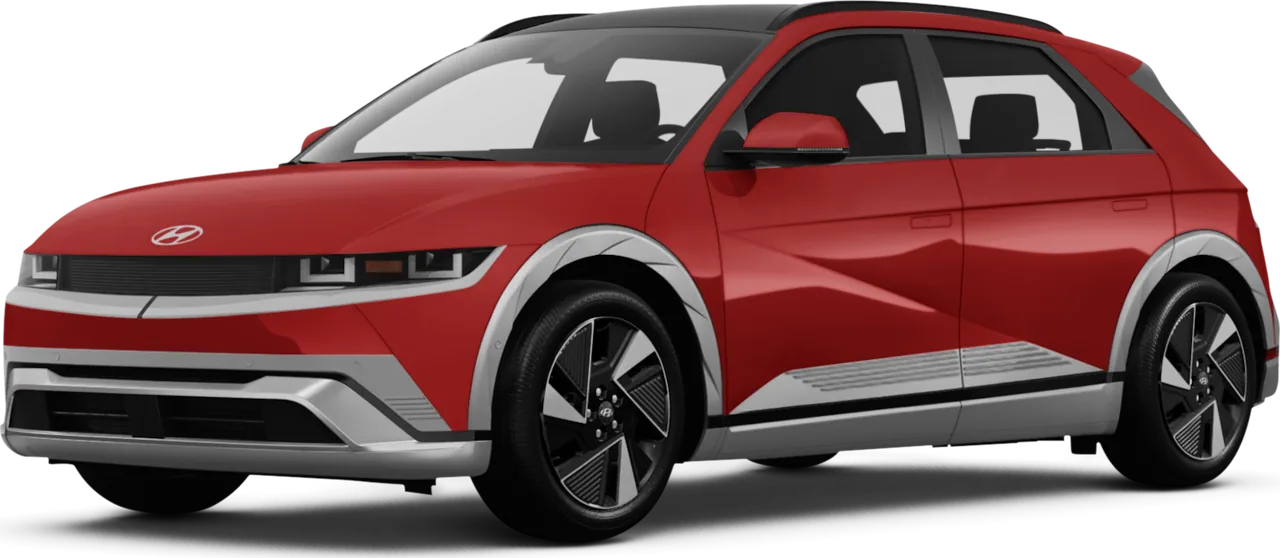
2026 Hyundai Ioniq 5 AWD XRT
Electric SUV · AWD
Based on battery health, build quality, owner data, EPA range, and market pricing
Below average for 2026 EV Compact SUVs (class avg 68)
Personalize this scoreIs a low score bad?
Last scanned 25 days ago
The 2026 Hyundai Ioniq 5 AWD XRT puts down 259 miles of EPA range, 235 kW fast charging and a 74 kWh battery, and a worth-pursuing score, but only after a hard inspection and a fair price.
Score read
A 65/100 makes this a records-first inspection. Do not let the composite hide this split: software and driver-assist score is 81/100, while range and efficiency score is 37/100. On Reddit, owners keep flagging the same two issues: owner satisfaction and battery degradation. Documented completion matters more than the recall count itself.
Price context
Used examples are running around $42,618. Treat that as a budgeting floor, not a final price; pull a current KBB Fair Purchase or Edmunds True Market Value for this exact trim before negotiating.
Who this is for
✓ Good for
- ⏱ Daily commuter ≤50 mi/day, predictable charging
✗ Avoid if you are a
- $ Bargain hunter Best TCO, reliability + low depreciation
Gotchas
- Serviceable Recall paperwork has to match the exact VIN.
Mitigation Use NHTSA and the automaker lookup, then require repair records instead of a verbal promise.
- Built in Range is the easy place to overbuy this trim (37/100).
Mitigation Check your commute, winter margin, and fast-charge plan before you assume the EPA number fits your use.
Pre-purchase inspection
- 1 Run the exact VIN through NHTSA and the automaker recall lookup before discussing price.
- 2 Compare the dashboard range estimate with the EPA 259-mile rating after a full charge.
- 3 Confirm how much of the 10-year/100,000-mile battery warranty remains and whether it transfers.
- 4 If road trips matter, run a short DC fast-charge session and watch whether speed tapers normally.
- 5 Map your normal highway route and winter margin against the EPA range before you treat it as a road-trip car.
VIN status first This model has 2 NHTSA recall records. The exact VIN lookup decides whether the car in front of you is clear.
Complaint context This scan found 13 NHTSA complaint records (1.3 per 10K VINs, low for any vehicle class). Read the themes below before treating the raw count as the verdict.
Price needs outside confirmation Current market pricing is incomplete, so MSRP should not be used as the deal signal. Compare KBB, J.D. Power, and live listings for this exact trim.
Pricing & Market Value
Score Breakdown
What matters most to you?
Drag the sliders to prioritize what you care about. Your TrimIndex Score recalculates instantly.
Vehicle Specifications
The federal $4,000 used-EV credit ended Sept 30, 2025.
But 10 states still run their own used-EV rebate programs — some up to $5,000. Pick your state to see what's available for this trim.
Source & disclaimer
Dealers make ~$3,575 on the average car loan.
After the price is set, the finance manager runs four plays to rebuild margin. Every buyer without a pre-approval is a target. Here's exactly what they run — and what stops each one.
78% of dealer loans carry a hidden +1.13% markup above what the lender actually charges. You never see it — it's buried in the contract. · CFPB
Dealer must match or beat your lender — they can't add margin invisibly. The markup play is dead on arrival.
Once you answer, they stretch the term to hit your number. Median result: $4K less off the price, 12 more months on the loan. · Industry avg
Financing is done. Only the sale price is on the table — and the dealer knows it.
Back-office F&I profit averages $1,975/vehicle, up 8.5% YoY. These products exist — but dealer markup is 4–10x what you'd pay elsewhere. · Dealership Guy
Dealer GAP runs $500–1K. Your insurer sells the same coverage for $100–250 over 5 years. Now you know.
"Your loan fell through — come re-sign." This pulls your APR up +5% on average. It's legal. It works because you've already driven the car home. · Ctr for Responsible Lending
A lender commitment letter means the deal is final. "Pending dealer approval" doesn't apply. You can't be yo-yo'd.
Margin handed to the dealer's finance department — for nothing.
Takes 2 minutes. No obligation to use it — but you'll walk in with all the leverage.
Pre-approval is a soft credit inquiry — no score impact. FICO treats all auto-loan hard pulls within 14 days as one, so you can still shop rates at the dealer.
NHTSA Recalls (2)
Hyundai Motor America (Hyundai) is recalling certain 2025-2026 IONIQ 5 and 2026 IONIQ 9 vehicles. The high voltage battery system may contain an improperly tightened bus bar, which can cause a short-circuit.
An electrical short in the high voltage battery system increases the risk of a fire.
Check VIN status at NHTSA.govHyundai Motor America (Hyundai) is recalling certain 2025-2026 Tucson Hybrid, Tucson Plug-In Hybrid Electric (PHEV), 2026 IONIQ 5, Santa Cruz, Kona, Palisade, Palisade Hybrid, Santa Fe, Santa Fe Hybrid, Sonata, Sonata Hybrid, and Tucson vehicles. Due to a software error, the instrument panel display may fail. As such, these vehicles fail to comply with the requirements of Federal Motor Vehicle Safety Standard (FMVSS) number 101, "Controls and Displays."
An instrument panel display that fails to show critical safety information, such as the speedometer or warning lights, increases the risk of a crash.
Check VIN status at NHTSA.govNHTSA Complaints (13 total · 1.3 per 10K US vehicles · low for any vehicle class)
The wiring for the air bag system under the driver's seat is exposed and unprotected which has led to disconnection and or damage to the wiring harness which then results in a disabled air bag system. This is a manufacturer design flaw and a serious safety issue. Other owners who have experienced damage to their wiring harness here have had disabled air bag systems for prolonged periods and costly repairs that Hyundai had refused to cover under warranty despite the fact that it is an obvious design flaw and a serious safety issue. See attached photos for evidence of how exposed this wiring harness is and suscebtible to damage as well as an example of damage which can occur which other owners have reported. Damage to this unit due to poor design results in compromised driver and passenger safety and extremely costly repairs ($10,000) which it appears Hyundai is refusing to cover under warranty. We request that this be recalled in order replace the design so this wiring harness is protected properly.
The wiring for the air bag system under the driver's seat is exposed and unprotected which has led to disconnection and or damage to the wiring harness which then results in a disabled air bag system. This is a manufacturer design flaw and a serious safety issue. Other owners who have experienced damage to their wiring harness here have had disabled air bag systems for prolonged periods and costly repairs that Hyundai had refused to cover under warranty despite the fact that it is an obvious design flaw and a serious safety issue. See attached photos for evidence of how exposed this wiring harness is and suscebtible to damage as well as an example of damage which can occur which other owners have reported. Damage to this unit due to poor design results in compromised driver and passenger safety and extremely costly repairs ($10,000) which it appears Hyundai is refusing to cover under warranty. We request that this be recalled in order replace the design so this wiring harness is protected properly.
While driving at highway speeds (approximately 70 MPH) with the vehicle's Assistive Driving functions engaged, the Driver Monitoring System (DMS) malfunctioned. Despite maintaining constant visual attention on the road ahead, the system issued repeated, erroneous audio warnings claiming driver inattention. I attempted to adjust my head and eye position to satisfy the sensors, but the system failed to register my compliance and continued to cycle through warnings. Consequently, the vehicle initiated an unwarranted "fail-safe" maneuver and suddenly applied the brakes while traveling in the flow of traffic. This uncommanded, rapid deceleration created an immediate and severe risk of a high-speed rear-end collision with following vehicles. The failure appears to be a false-positive defect in the eye-tracking software logic and its integration with the braking system. The vehicle is available for inspection to analyze the system data logs.
While driving at highway speeds (approximately 70 MPH) with the vehicle's Assistive Driving functions engaged, the Driver Monitoring System (DMS) malfunctioned. Despite maintaining constant visual attention on the road ahead, the system issued repeated, erroneous audio warnings claiming driver inattention. I attempted to adjust my head and eye position to satisfy the sensors, but the system failed to register my compliance and continued to cycle through warnings. Consequently, the vehicle initiated an unwarranted "fail-safe" maneuver and suddenly applied the brakes while traveling in the flow of traffic. This uncommanded, rapid deceleration created an immediate and severe risk of a high-speed rear-end collision with following vehicles. The failure appears to be a false-positive defect in the eye-tracking software logic and its integration with the braking system. The vehicle is available for inspection to analyze the system data logs.
My car would no longer charge after testing various chargers at home and different public charging stations. If this had happened away from home, and without cell service, I might have been stranded. I took I into the Hyundai service center, and they said the ICCU had failed. They replaced if after waiting a week for the part.
My car would no longer charge after testing various chargers at home and different public charging stations. If this had happened away from home, and without cell service, I might have been stranded. I took I into the Hyundai service center, and they said the ICCU had failed. They replaced if after waiting a week for the part.
ICCU and fuse broken
ICCU and fuse broken
Upon delivery of a brand new 2026 Hyundai Ioniq 5 with 13 miles on the odometer, the washer fluid warning illuminated the next day. Reservoir was refilled on 3/29 and was completely empty by 3/30. Vehicle was brought to the authorized dealer on 3/31. The technician confirmed via repair order that the washer fluid hose was actively spouting directly above the ICCU — Integrated Charging Control Unit — a safety-critical high voltage component. Washer fluid was confirmed present in the ICCU floor pan. The cause was a nail severing the washer fluid line. The dealer confirmed the vehicle sat on their lot approximately 70 days before the 3/23/26 delivery date and that washer fluid is factory pre-filled. This indicates the leak was active for approximately 70 days before delivery, during which washer fluid leaked above the ICCU and surrounding electronics. Repair required complete interior disassembly — seats, carpet, center console, floor trim — on a 156-mile brand new vehicle. A full floor wire harness was replaced under Hyundai Techline authorization. Soaked carpet and insulation were salvaged outside rather than replaced. Hyundai Motor America declined to proactively replace the ICCU despite documented fluid exposure above it and denied an extended warranty request covering affected electronics. Safety concern: internal corrosion from extended fluid exposure may not present immediately but can cause sudden loss of drive power — a known ICCU failure mode on this platform subject to multiple prior recalls. Loss of drive power at highway speed poses serious safety risk.
Upon delivery of a brand new 2026 Hyundai Ioniq 5 with 13 miles on the odometer, the washer fluid warning illuminated the next day. Reservoir was refilled on 3/29 and was completely empty by 3/30. Vehicle was brought to the authorized dealer on 3/31. The technician confirmed via repair order that the washer fluid hose was actively spouting directly above the ICCU — Integrated Charging Control Unit — a safety-critical high voltage component. Washer fluid was confirmed present in the ICCU floor pan. The cause was a nail severing the washer fluid line. The dealer confirmed the vehicle sat on their lot approximately 70 days before the 3/23/26 delivery date and that washer fluid is factory pre-filled. This indicates the leak was active for approximately 70 days before delivery, during which washer fluid leaked above the ICCU and surrounding electronics. Repair required complete interior disassembly — seats, carpet, center console, floor trim — on a 156-mile brand new vehicle. A full floor wire harness was replaced under Hyundai Techline authorization. Soaked carpet and insulation were salvaged outside rather than replaced. Hyundai Motor America declined to proactively replace the ICCU despite documented fluid exposure above it and denied an extended warranty request covering affected electronics. Safety concern: internal corrosion from extended fluid exposure may not present immediately but can cause sudden loss of drive power — a known ICCU failure mode on this platform subject to multiple prior recalls. Loss of drive power at highway speed poses serious safety risk.
On April 12, 2026, I was using the parallel parking assist feature on my 2026 Hyundai Ioniq 5 Limited AWD. I was parking on perfectly level ground with a parked vehicle behind the empty space I was attempting to enter. During the maneuver, the collision sensors activated, but the vehicle continued accelerating toward the parked car. I had to press the brake to stop the vehicle and avoid a collision. This created a safety concern because the system appeared to continue the maneuver despite the active collision warnings.
On April 12, 2026, I was using the parallel parking assist feature on my 2026 Hyundai Ioniq 5 Limited AWD. I was parking on perfectly level ground with a parked vehicle behind the empty space I was attempting to enter. During the maneuver, the collision sensors activated, but the vehicle continued accelerating toward the parked car. I had to press the brake to stop the vehicle and avoid a collision. This created a safety concern because the system appeared to continue the maneuver despite the active collision warnings.
While driving at most speeds vehicle feels like it is pulsing in power. It’s an EV and I can best describe the feeling to be like when a gas powered vehicle has a severe skip in the engine
While driving at most speeds vehicle feels like it is pulsing in power. It’s an EV and I can best describe the feeling to be like when a gas powered vehicle has a severe skip in the engine
I am writing to report a serious safety concern regarding the “Consider Taking a Break” driver alert system in my new 2026 Hyundai Ioniq 5 Limited, which currently has 515 miles. This notification is presenting itself in a way that I believe creates a distraction and potential hazard while driving. The alert appears frequently and without clear justification, even when I am fully alert and in control of the vehicle. Rather than enhancing safety, it draws unnecessary attention away from the road and contributes to driver frustration. From a safety standpoint, any system that interrupts driver focus—especially without accurate or consistent triggering criteria—can increase risk rather than reduce it. This is particularly concerning in real-world driving conditions where attention needs to remain uninterrupted. Due to this issue, I am seriously considering returning the vehicle, as I do not feel confident in a system that behaves unpredictably and may compromise safety. I strongly urge Hyundai to: - Investigate this behavior immediately - Issue a recall or software update to correct it - Provide owners with the ability to disable or customize this alert I have also included NHTSA on this email, as I believe this warrants broader review as a potential safety defect. Please advise on next steps and whether a fix is currently in development. Thank you for your prompt attention to this matter. Sincerely, [XXX] [XXX] [XXX] INFORMATION REDACTED PURSUANT TO THE FREEDOM OF INFORMATION ACT (FOIA), 5 U.S.C. 552(B)(6)
I am writing to report a serious safety concern regarding the “Consider Taking a Break” driver alert system in my new 2026 Hyundai Ioniq 5 Limited, which currently has 515 miles. This notification is presenting itself in a way that I believe creates a distraction and potential hazard while driving. The alert appears frequently and without clear justification, even when I am fully alert and in control of the vehicle. Rather than enhancing safety, it draws unnecessary attention away from the road and contributes to driver frustration. From a safety standpoint, any system that interrupts driver focus—especially without accurate or consistent triggering criteria—can increase risk rather than reduce it. This is particularly concerning in real-world driving conditions where attention needs to remain uninterrupted. Due to this issue, I am seriously considering returning the vehicle, as I do not feel confident in a system that behaves unpredictably and may compromise safety. I strongly urge Hyundai to: - Investigate this behavior immediately - Issue a recall or software update to correct it - Provide owners with the ability to disable or customize this alert I have also included NHTSA on this email, as I believe this warrants broader review as a potential safety defect. Please advise on next steps and whether a fix is currently in development. Thank you for your prompt attention to this matter. Sincerely, [XXX] [XXX] [XXX] INFORMATION REDACTED PURSUANT TO THE FREEDOM OF INFORMATION ACT (FOIA), 5 U.S.C. 552(B)(6)
Every 7 minutes of driving electrical failure, happens, which results in Check driver assistance system warning. Once vehicle is turned off, driving 7 minutes error pops again. Due to this all systems: Adaptive Cruise Control, Automatic Emergency Braking, Blind Spot Warning, Forward Collision Warning, Lane Departure Warning, Lane Keeping Assistance, Parking Collision Warning, Rear Cross Traffic Warning gets disabled. This creates a huge risk driving.
Every 7 minutes of driving electrical failure, happens, which results in Check driver assistance system warning. Once vehicle is turned off, driving 7 minutes error pops again. Due to this all systems: Adaptive Cruise Control, Automatic Emergency Braking, Blind Spot Warning, Forward Collision Warning, Lane Departure Warning, Lane Keeping Assistance, Parking Collision Warning, Rear Cross Traffic Warning gets disabled. This creates a huge risk driving.
The contact owns a 2026 Hyundai Ioniq 5. The contact stated that while charging the vehicle at the workplace, the vehicle started flashing a message "Charging was Unsuccessful". The contact was able to drive the vehicle to the residence; however, the door locks were making clicking sounds. The contact stated that the vehicle was parked in the driveway and the key fob failed to unlock or lock the doors. The contact called the local dealer, who advised her not to drive the vehicle. The vehicle was towed by the dealer to be diagnosed, and the dealer informed the contact that the Integrated Charging Control Unit (ICCU) had failed and needed to be replaced. The vehicle was not yet repaired. The manufacturer was not informed of the failure. The failure mileage was approximately 160.
The contact owns a 2026 Hyundai Ioniq 5. The contact stated that while charging the vehicle at the workplace, the vehicle started flashing a message "Charging was Unsuccessful". The contact was able to drive the vehicle to the residence; however, the door locks were making clicking sounds. The contact stated that the vehicle was parked in the driveway and the key fob failed to unlock or lock the doors. The contact called the local dealer, who advised her not to drive the vehicle. The vehicle was towed by the dealer to be diagnosed, and the dealer informed the contact that the Integrated Charging Control Unit (ICCU) had failed and needed to be replaced. The vehicle was not yet repaired. The manufacturer was not informed of the failure. The failure mileage was approximately 160.
The vehicle cannot initiate a level 2 charging session due to a ground fault error. Multiple charging stations were attempted with different charging connectors and adapters. Only DC fast charging works on the vehicle now. This vehicle has been leased for less than 60 days.
The vehicle cannot initiate a level 2 charging session due to a ground fault error. Multiple charging stations were attempted with different charging connectors and adapters. Only DC fast charging works on the vehicle now. This vehicle has been leased for less than 60 days.
My BRAND NEW car is suffering an ICCU issue. I first noticed the screens going completely black while driving. I then noticed that I can’t charge at all on Lvl 1 and Lvl2 chargers (AC), but I went to the dealership and the helped me charge on lvl 3 DC fast charging. This is an incredibly dangerous problem, if this results in my 12V battery dying, I could be stranded while driving.
My BRAND NEW car is suffering an ICCU issue. I first noticed the screens going completely black while driving. I then noticed that I can’t charge at all on Lvl 1 and Lvl2 chargers (AC), but I went to the dealership and the helped me charge on lvl 3 DC fast charging. This is an incredibly dangerous problem, if this results in my 12V battery dying, I could be stranded while driving.
The right front tire pressure sensor (TPS) indicates low inflation when the tire is inflated properly. The sensor will not reset on its own even when the tire is filled to manufacturer standards. Social media forums discuss this as a reoccurring problem in previous and current models.
The right front tire pressure sensor (TPS) indicates low inflation when the tire is inflated properly. The sensor will not reset on its own even when the tire is filled to manufacturer standards. Social media forums discuss this as a reoccurring problem in previous and current models.
What Owners Are Saying
"Tracked my old Ioniq 5 after return - 2 1/2 years 30,000 + miles - battery still 100% On March 28th, I turned in my leased 2024 Hyundai Ioniq 5 Limited AWD (30,580 miles / $41,000 residual) to a local Hyundai dealership in Illinois and leased a new 2026 AWD Limited ($557 OTD including taxes and fees, 36 months, 10K/year). This week, I followed the car on Bluelink. Over three days, it was transported 640 miles and ended up in Richmond, Virginia at a 100% EV reseller — “Recharged” — a CarMax-like company that inspects, reconditions, and, most importantly, tests and rates remaining battery health. For better or worse, I always charged to 100% after roughly 60–150 miles between charges. Recharged’s battery health report, using a Voltest device, shows 100% state of health and indicates that 95% of charging was slow charging — which accurately reflects my home Level 2 charging at 11 kW, with only occasional 350 kW fast charging via Electrify America during the 2 years of free charging that came with the 2024 Ioniq 5. It’s now listed for sale on Recharged.com for $31,998."
"We didn’t actually go camping in our Ioniq 5, but who did go on a 2500 mile road trip in it, and the back cargo area is huge when you fold down the second row. It had V2 L and our 2024 model had wired CarPlay. The 2025 and newer, will have wireless CarPlay. We liked the car very much, but unfortunately, it was totalled in an accident."
"U.S. News Names Hyundai EVs Among Best Family Cars For 2026 Article: With ample room for strollers, soccer gear and a trunk full of luggage and snacks for that upcoming family vacation, the Hyundai Ioniq 9 isn’t that shocking of a win in U.S. News & World Report’s 2026 Best Cars for Families list, released late Wednesday. The Hyundai brand swept the two pure electric vehicle titles: The 2026 Ioniq 9 for “Best Midsize EV SUV for Families” and the smaller 2026 Ioniq 5 for “Best Compact EV SUV for Families.” U.S. News Autos’ managing editor Alex Kwanten said in a phone call both Ioniqs are first and foremost good overall EVs with fast charging and ample safety features, but bonus comfort, tech and entertainment features make them exceptional family cars. “You’ll save money and time,” he said, reminding drivers about lower energy costs (gas prices have skyrocketed this week amid the war in Iran, and auto research firm Edmunds found 20.7% increased interest in EVs from the previous week), at home charging ("You’ll never have to go to a gas station!") and fast-charging at public charging networks. The Ioniq 9 arrived last year as the notably bigger brother to the Ioniq 5 (even if it arrived years later). It seats six or seven passengers with three rows and offers almost 22 cubic-feet of trunk space with the third row in use. Folded, it expands to 46.7 cubes and a whopping 86.9 cubic-feet with both rows down. The Ioniq 9 starts at $58,955 for the base S trim with about 335-mile range. It’s one of few choices for a three-row all-electric. US-AUTO-SHOW The Hyundai Ioniq 5 has been a top EV since its debut in 2021. The Ioniq 5, which started production back in 2021, is a popular compact SUV EV with one of the lower starting prices for an all-electric option at $35,000 for the base. It has up to 318-mile range and is known for fast charging. It is consistently one of the top-five best-selling EVs in the U.S. going up against the Ford Mustang Mach-E, Tesla Model Y, Volkswagen ID.4 and its shared platform car, the Kia EV6. Other plug-in categories include “Best PHEV SUV for Families,” a new category for 2026, which went to the 2026 Mazda CX-90 PHEV. The plug-in version has a 2.5-liter four-cylinder engine and electric motor. It offers 26 miles of electric-only range on a single charge. Its total range is 490 miles. The PHEV starts at $50,495. Hyundai brought in three other awards for a high-score of five total, two for its hybrid SUVs, Palisade and Tucson, and the other for its gas-powered Tucson for “Best Compact SUV.” Toyota’s only win was for the Tundra—yes, a truck—for the “Best Fullsize Pickup Truck” category. Tesla did not make the list despite the Model Y’s impressive sales in 2025 making it the best-selling EV in the U.S. But as Kwanten reiterated about the award winners, “It’s not a popularity contest.” U.S. News made its Best Cars for Families list by looking at cars’ overall rating on its rankings, which includes safety data, reliabili"
"Hyundai IONIQ 5 gets a bigger battery and 690 km range. But at ₹55 lakh, who is it really for? Hyundai Motor India has updated the Hyundai IONIQ 5 with a larger battery, more range, and a handful of tech upgrades. On paper, the jump to a claimed 690 km range is the headline. But the bigger question is whether this actually changes its position in India’s premium EV space. **So what?** * Range anxiety was one of the last real concerns in this segment. Hyundai has largely solved that * The focus is now shifting from just “EV” to **experience: software, connectivity, and convenience** * But at ₹55.7 lakh, this is still a niche product in India This update is less about volume and more about keeping Hyundai relevant in the high-end EV conversation. **The breakdown:** * Price: * ₹55.70 lakh (ex-showroom) * Biggest upgrade: * Battery: 84 kWh * Range: up to 690 km * Design: * Subtle refresh * Updated bumpers, alloys, spoiler * Signature pixel lighting retained **Interior and tech updates:** * Dual 12.3-inch screens remain * New 3-spoke steering wheel with illuminated design * Wireless Android Auto + Apple CarPlay (finally) * New ccNC system with OTA updates **New additions that stand out:** * In-car payment for EV charging * Remote immobilisation via Bluelink * Physical controls added for seat functions This is where the car feels more “2026-ready” than before. **Safety updates:** * Parking Collision-Avoidance Assist (rear) * Improved parking sensors for tight urban use Not a full overhaul, but useful upgrades for daily driving in Indian cities. **Reality check:** * ₹55 lakh puts it firmly in luxury territory * Charging infrastructure still limits real-world convenience outside metros * 690 km is certified range. Real-world numbers will be lower **Where it stands:** * Strong on design and tech * Now stronger on range * Still limited by price and ecosystem Would you spend ₹55 lakh on a premium EV like the IONIQ 5, or does it still make more sense to wait for better infrastructure and more options in India?"
"Hyundai Ioniq 5 major issue: Sudden lurching/braking. Requires $8,000+ fix: Traction Motor Assembly, MCU, Rear Motor Assembly replacement. I'm mainly posting this so that other people with this problem can find info on it. Despite several previous searches, it seems like I'm one of the first few posting about it. We (my husband and I) have a 2022 RWD SE model of Hyundai Ioniq 5 with 160,000 miles on it. We bought it a couple years ago for $30,000 and it had 22,000 miles on it. (Edit: we rechecked, it's at about 53,000 miles a year). For a used car, it was basically new because it was previously a lease car from that same Hyundai dealership. There were no previously reported problems, accidents, and it had a good service history. Despite being driven constantly, it was well taken care of, including coolant changes at the dealership. We serviced it consistently, got new tires as needed, etc. It drove great and it really performed fantastically! Super comfortable, fun to drive. Until... Our issue seemed small at first: The car would randomly lurch, resulting in a sudden loss of acceleration. Imagine the feeling of a heavy gear shift in a non-luxury gas car. Or imagine somebody randomly tapping the brake. Sometimes, but not always and *not* predictably, we would get a yellow warning message if the battery was near full (90%-98%). Something like **\[Regeneration not available, battery fully charged\]**. This was mildly concerning but at most annoying. We tried to figure out what caused it at first...We couldn't tell if weather was a factor, but this happened during cool winter months (about 20-40 degrees F). Car speed, driving uphill or downhill, weight load, etc did not seem to affect the issue frequency. We actually had an OBD2 car code reader, and initially didn't find anything but in the middle of the saga did see a historic error code about motor overcurrent. This went on for about a month. Speed limit function was not turned on. We turned off everything that could be remotely software related too. We were not getting the "power limited" turtle icon (if you are, here's a link to that issue: After we saw the motor overcurrent error we took it in to the dealership service center. But since the issue was triggered randomly / intermittently and the driver couldn't influence frequency, the techs couldn't reproduce it. They didn't charge us and told us to come back if it kept happening. Well, it kept happening, but we decided that we could live with it and still be pretty happy with the car as long as nothing got worse. So of course it got way worse. Within a couple of weeks, the car gave us a critical error and while it didn't shut off, it would not accelerate / maintain spe"
"ICCU worries I really like the Hyundai Ioniq 5. The design, the interior space, the ride quality. it just feels like a well thought-out EV overall. But here’s the thing that’s holding me back: the ICCU issue. I’ve been reading about cases where the car suddenly throws errors, stops charging, or even leaves people stranded because of ICCU failures. I know there have been recalls and software updates, but it still feels like this could happen anytime without warning. I am worried I will be stranded on a highway and without a car for 3-4 weeks. So I’m trying to understand how others are thinking about this before buying: • Are you just trusting the recall fixes and moving forward? • Does warranty coverage make this a non-issue for you? • Or are you factoring this risk into price negotiations / deciding to lease instead of buy? • Have any backup plans? I really want to go for this car, but this one thing is stopping me. Curious how you all are thinking about it. CR ARTICLE: Update: Thanks for all the comments. Really appreciate it. For now, I have decided to not to buy Ioniq5. Hopefully the fix comes soon. Thanks again."
"navigating hi5 battery enclosure damage / possible total loss I’m in the middle of an insurance claim and looking for perspective from folks who’ve been through something similar. Situation: • 2023 Hyundai Ioniq 5 SEL AWD • Low speed incident in a mixed paved and dirt parking lot • Underbody impact • No injuries, no other vehicles involved • Dealer inspected and is indicating possible battery enclosure involvement (pics attached) • Insurance (Travelers) has it classified as at fault collision with deductible applying • Vehicle is currently sitting at the dealer while adjusters work through repair vs total loss What I’m trying to understand from others who’ve been here: • If your EV was repaired after underbody or battery adjacent damage, did you regret not pushing for a total? • If it was repaired, anything you wish you had done differently during repairs? • Any other pitfalls to avoid? I’m intentionally staying hands off with the dealer and letting insurance coordinate, but curious if that’s the right posture or if there are moments where being more proactive helped. Not looking to assign blame or argue fault. Just trying to make smart decisions and avoid unforced errors. Appreciate any m real world experience or lessons learned."
"Hyundai Ioniq 5 rear clicking/metallic sound - Solved I want to share my experience with a metallic clicking noise coming from the rear of my Hyundai IONIQ 5 (2022). First of all, this is NOT the common issue that’s fixed by replacing the tailgate rubber stoppers (TSB 24-BD-012H) or applying tape to the tailgate latch. This particular problem occurs in cars with a glass roof or solar roof (which I have). There is also an official Hyundai TSB for it (TSB HSE23-91-P660-NE). I ended up fixing it using whatever I had on hand: hammer, flathead screwdriver and two self-tapping screws (DIN 7504 K, 6.3x90 — not 100% sure about the exact size, but something similar should work). Here’s what I did: * Disconnected the 12v battery terminal * Folded down the rear seats * Removed the upper plastic trim in the trunk * Unscrewed the rear passenger ceiling handles * Removed 3 clips from the rear headliner * Slightly lowered the rear part of the headliner to access the areas described in the TSB (Be careful not to deform the headliner — it actually restores itself pretty well after reassembly.) * Inserted a screwdriver into the seam with purple sealant and hit it firmly with a hammer in about 5 different spots along the joint * Did the same with a screw — tapping it in across multiple points * Finally, I hammered one screw deeper toward the center of the car and checked by hand that it was seated very firmly. * Repeated the same process on the other side * Folded the seats back up * Placed extra cushions between the headrest and the headliner to prevent movement * Went for a test drive. If the noise disappears completely, I recommend driving at least another 50 km to confirm the fix before reassembling everything. Yes — I left the screws in place. They don’t interfere with the headliner. I understand there are probably more appropriate solutions, but this is what I had available. So yeah… kind of absurd that even with an active warranty, you still end up fixing this yourself. Now about the official Hyundai dealer in Norway: At first, I went to the dealer and they replaced the tailgate rubber stoppers — no result. Then I tried taping various potential contact points and adjusting the lower bump stops — still nothing. I went back to the dealer a second time, clearly explaining the issue and even showing them TSB HSE23-91-P660-NE as a possible cause. They attempted to fix it, but it didn’t help — in fact, the noise got worse about a week later.On my third visit, they simply refused to take the car in, saying that this noise is “normal for this model.” In my opinion, Hyundai has the worst service I’ve experienced. No matter what issue I bring up, their default answer is: “this is how it’s supposed to be.” For example, my battery preconditioning wasn’t working due to outdated BMS software. At first, they claimed the feature was only available on 2025 models. It took me a full month to prove otherwise. Eventually, they contacted headquarters and received upda"
Showing 8 of 16 owner excerpts (sorted by sentiment strength)