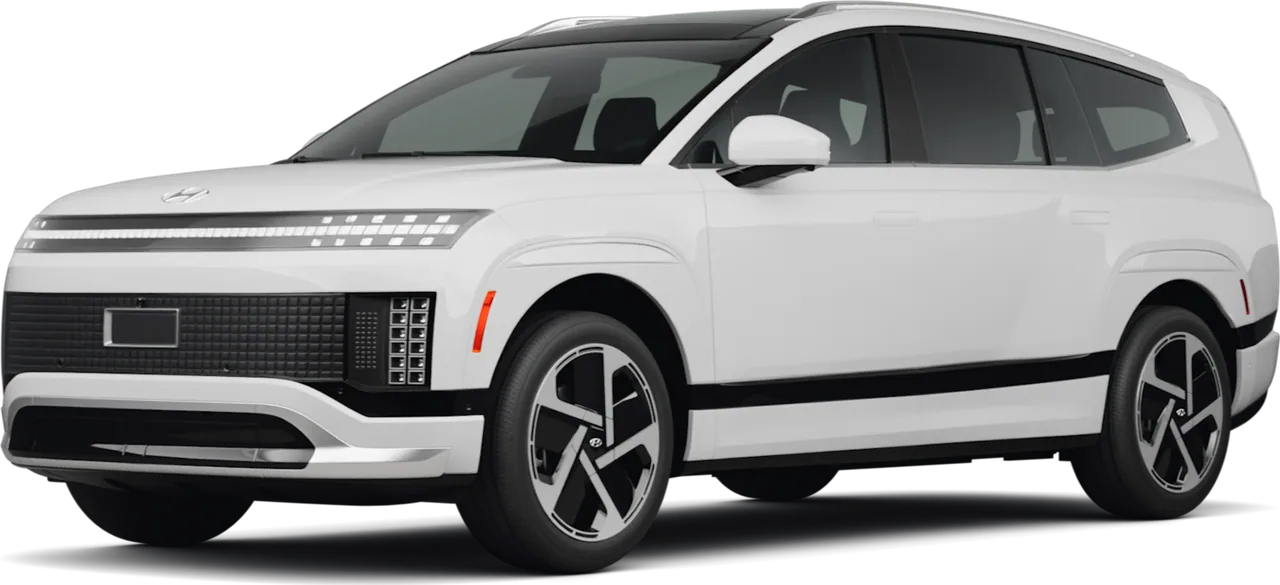
2026 Hyundai Ioniq 9 AWD Performance
Premium Electric SUV · AWD
Based on battery health, build quality, owner data, EPA range, and market pricing
Above average for 2026 EV SUVs (class avg 66 · top 14%)
Personalize this scoreIs a low score bad?
Last scanned 22 days ago
The 2026 Hyundai Ioniq 9 AWD Performance has 311 miles of EPA range, 230 kW fast charging and a 96 kWh battery, and the score gets it into the conversation; battery and service records decide whether to make an offer.
Score read
A 72/100 makes this good enough to inspect, not good enough to skip diligence. Do not let the composite hide this split: software and driver-assist score is 100/100, while owner feedback score is 48/100. Owners on Reddit repeatedly cite owner satisfaction and range as recurring problems. Documented completion matters more than the recall count itself.
Price context
This trim started from $71,250 new. Used examples have come down since launch, but pricing varies by miles, condition, and how the model is moving right now; pull a current KBB Fair Purchase, an Edmunds True Market Value, or an active dealer listing for this exact trim, and anchor your offer there. Walk if the seller will not move off new-car-style pricing.
Who this is for
✓ Good for
- ⏱ Daily commuter ≤50 mi/day, predictable charging
- ↦ Road tripper Long trips, needs DC fast network
- ★ Weekend driver Performance, fun, low mileage
✗ Avoid if you are a
- $ Bargain hunter Best TCO, reliability + low depreciation
Gotchas
- Serviceable Recall paperwork has to match the exact VIN.
Mitigation Use NHTSA and the automaker lookup, then require repair records instead of a verbal promise.
- Verify Owner feedback is the part to read carefully (48/100).
Mitigation Read the complaint themes and ask whether this VIN has already had those issues repaired.
- Verify Current market pricing is not confirmed well enough for this trim.
Mitigation Compare KBB, J.D. Power, and live listings for the same trim before treating price as a buying signal.
Pre-purchase inspection
- 1 Run the exact VIN through NHTSA and the automaker recall lookup before discussing price.
- 2 Compare the dashboard range estimate with the EPA 311-mile rating after a full charge.
- 3 Confirm how much of the 10-year/100,000-mile battery warranty remains and whether it transfers.
- 4 If road trips matter, run a short DC fast-charge session and watch whether speed tapers normally.
- 5 Read the complaint themes, not just the count, and ask the seller whether those issues have shown up on this VIN.
VIN status first This model has 1 NHTSA recall record. The exact VIN lookup decides whether the car in front of you is clear.
Complaint context This scan found 14 NHTSA complaint records (28 per 10K VINs, elevated — verify before purchase). Read the themes below before treating the raw count as the verdict.
Price needs outside confirmation Current market pricing is incomplete, so MSRP should not be used as the deal signal. Compare KBB, J.D. Power, and live listings for this exact trim.
Pricing & Market Value
Score Breakdown
What matters most to you?
Drag the sliders to prioritize what you care about. Your TrimIndex Score recalculates instantly.
Vehicle Specifications
The federal $4,000 used-EV credit ended Sept 30, 2025.
But 10 states still run their own used-EV rebate programs — some up to $5,000. Pick your state to see what's available for this trim.
Source & disclaimer
Dealers make ~$3,575 on the average car loan.
After the price is set, the finance manager runs four plays to rebuild margin. Every buyer without a pre-approval is a target. Here's exactly what they run — and what stops each one.
78% of dealer loans carry a hidden +1.13% markup above what the lender actually charges. You never see it — it's buried in the contract. · CFPB
Dealer must match or beat your lender — they can't add margin invisibly. The markup play is dead on arrival.
Once you answer, they stretch the term to hit your number. Median result: $4K less off the price, 12 more months on the loan. · Industry avg
Financing is done. Only the sale price is on the table — and the dealer knows it.
Back-office F&I profit averages $1,975/vehicle, up 8.5% YoY. These products exist — but dealer markup is 4–10x what you'd pay elsewhere. · Dealership Guy
Dealer GAP runs $500–1K. Your insurer sells the same coverage for $100–250 over 5 years. Now you know.
"Your loan fell through — come re-sign." This pulls your APR up +5% on average. It's legal. It works because you've already driven the car home. · Ctr for Responsible Lending
A lender commitment letter means the deal is final. "Pending dealer approval" doesn't apply. You can't be yo-yo'd.
Margin handed to the dealer's finance department — for nothing.
Takes 2 minutes. No obligation to use it — but you'll walk in with all the leverage.
Pre-approval is a soft credit inquiry — no score impact. FICO treats all auto-loan hard pulls within 14 days as one, so you can still shop rates at the dealer.
NHTSA Recalls (1)
Hyundai Motor America (Hyundai) is recalling certain 2025-2026 IONIQ 5 and 2026 IONIQ 9 vehicles. The high voltage battery system may contain an improperly tightened bus bar, which can cause a short-circuit.
An electrical short in the high voltage battery system increases the risk of a fire.
Check VIN status at NHTSA.govNHTSA Complaints (14 total · 28 per 10K US vehicles · elevated — verify before purchase)
Two safety incidents occurred (October and November 2025) involving the power-folding second-row seats. A child was seated in the second-row captain’s chair when a sibling activated the seat from the third row. The seat failed to detect the occupant and continued moving forward, creating a crushing hazard. In one incident, my daughter (approx. 40 lbs, 46 inches tall) was partially trapped and screamed as the seat compressed her and/or tightened the seatbelt. I had to intervene to stop the mechanism. I later tested this myself and confirmed the issue is reproducible. While seated, the seat continued moving forward and pushed me into the front passenger seat without automatically stopping. This demonstrates a failure of occupant detection and/or lack of a safety stop mechanism. This presents a serious injury risk, especially to children. The issue was demonstrated to a dealership representative.
Two safety incidents occurred (October and November 2025) involving the power-folding second-row seats. A child was seated in the second-row captain’s chair when a sibling activated the seat from the third row. The seat failed to detect the occupant and continued moving forward, creating a crushing hazard. In one incident, my daughter (approx. 40 lbs, 46 inches tall) was partially trapped and screamed as the seat compressed her and/or tightened the seatbelt. I had to intervene to stop the mechanism. I later tested this myself and confirmed the issue is reproducible. While seated, the seat continued moving forward and pushed me into the front passenger seat without automatically stopping. This demonstrates a failure of occupant detection and/or lack of a safety stop mechanism. This presents a serious injury risk, especially to children. The issue was demonstrated to a dealership representative.
When my Ioniq 9 was in reverse, the brake did not work. The car kept rolling and I had to turn it off to stop the car.
When my Ioniq 9 was in reverse, the brake did not work. The car kept rolling and I had to turn it off to stop the car.
Vehicle was operating perfect then got alert indicating electrical system fault but vehicle still drove (was just 2 miles from home ) but then alarms sounded and just able to pull off road before vehicle died. Checked and see code DTC PIA9096 and car was inoperable after. Towed to dealer for replacement of ICCU module. They acknowledged they have seen this before. I was on a local road, but if this happened on a highway, would have been more hazardous!
Vehicle was operating perfect then got alert indicating electrical system fault but vehicle still drove (was just 2 miles from home ) but then alarms sounded and just able to pull off road before vehicle died. Checked and see code DTC PIA9096 and car was inoperable after. Towed to dealer for replacement of ICCU module. They acknowledged they have seen this before. I was on a local road, but if this happened on a highway, would have been more hazardous!
Failure of the ICCU during normal driving conditions. The vehicle was controllable, and driver was able to bring the vehicle to a safe location as vehicle performance deteriorated. The failure left the driver and passenger without power during a storm in an unfamiliar area. After about 45 minutes of waiting for roadside assistance, the vehicle lost all auxiliary power and no functions were available (including lights and door lock controls). Vehicle was towed to a local dealership, where issue was diagnosed and part has been replaced. The failure was not preceded by any significant event. Warnings present on the driver's information panel while driving.
Failure of the ICCU during normal driving conditions. The vehicle was controllable, and driver was able to bring the vehicle to a safe location as vehicle performance deteriorated. The failure left the driver and passenger without power during a storm in an unfamiliar area. After about 45 minutes of waiting for roadside assistance, the vehicle lost all auxiliary power and no functions were available (including lights and door lock controls). Vehicle was towed to a local dealership, where issue was diagnosed and part has been replaced. The failure was not preceded by any significant event. Warnings present on the driver's information panel while driving.
Suspected ICCU failure. Progressed rapidly to car being immobile. Known issue not being addressed by Hyundai.
Suspected ICCU failure. Progressed rapidly to car being immobile. Known issue not being addressed by Hyundai.
The vehicle was being driven on a city street when it suddenly felt sluggish and lost acceleration ability. It would not drive above 43mph in a 50mph zone. The display showed the error "Check electrical vehicle system". After getting home a mile away and turning it on, driving was tested again after about 30 minutes. Upon entering drive mode, it beeps rapidly and displayed "Stop vehicle and check power supply". Battery would not charge, with the vehicle announcing "Charge unsuccessful". The Hyundai app shows an ELECTRIC VEHICLE DTC P1A9096 and DTC Sub System: Air Flap (which appears to be incorrect since the air flap is functional and it's an ICCU failure). The dealer inspected and diagnosed the issue as an ICCU failure, requiring a new ICCU and fuses. Parts are on backorder with availability unknown.
The vehicle was being driven on a city street when it suddenly felt sluggish and lost acceleration ability. It would not drive above 43mph in a 50mph zone. The display showed the error "Check electrical vehicle system". After getting home a mile away and turning it on, driving was tested again after about 30 minutes. Upon entering drive mode, it beeps rapidly and displayed "Stop vehicle and check power supply". Battery would not charge, with the vehicle announcing "Charge unsuccessful". The Hyundai app shows an ELECTRIC VEHICLE DTC P1A9096 and DTC Sub System: Air Flap (which appears to be incorrect since the air flap is functional and it's an ICCU failure). The dealer inspected and diagnosed the issue as an ICCU failure, requiring a new ICCU and fuses. Parts are on backorder with availability unknown.
The car’s electrical system failed while I was going at high speeds on the freeway. Red alarm notices popped up on the screen stating “check electric system”. It promptly slowed from 75+ mph to 40 mph on a major highway. My children and I could have been seriously injured. I had to then go across high speed freeway lanes at a slow speed while everyone else is driving 70+ to exit. The dealership is still identifying the issue. On the Hyundai app it shows the error code of P1A9096 which is the same error code on a recall of Ioniq cars from two years ago. It is an ICCU issue in their EV cars that has still not been fixed. There were no warning signs whatsoever. I just got this new 2026 car in September of 2025 - not even 6 months old.
The car’s electrical system failed while I was going at high speeds on the freeway. Red alarm notices popped up on the screen stating “check electric system”. It promptly slowed from 75+ mph to 40 mph on a major highway. My children and I could have been seriously injured. I had to then go across high speed freeway lanes at a slow speed while everyone else is driving 70+ to exit. The dealership is still identifying the issue. On the Hyundai app it shows the error code of P1A9096 which is the same error code on a recall of Ioniq cars from two years ago. It is an ICCU issue in their EV cars that has still not been fixed. There were no warning signs whatsoever. I just got this new 2026 car in September of 2025 - not even 6 months old.
I purchased the car on January 13 2026 the car was dellry to my house that night around 5:50 pm MT two days later my Control Unit (CU) went bad the car went back to the dealership with the first available appointment on the 20th I was told the CU needed to be replace. the car was ready for pick up on the 29th. I received the car at 5:40 pm MT on January 30th around 6:39am MT. I started the car and was going to go to the dealership and less then 2 mins information cam on the dash saying stop vehicle and check power supply. I tired to drive to the dealership but the car would not going pass 24mph and would be unsafe to drive. so I got it towed to the dealership later I was called and told the Integrated Charging Control Unit (ICCU) is often referred to as a critical "brain" or "heart" of the vehicle's power management system is bad and needs to be replace. after that I did research on the ICCU and found on this is a common problem with Hyundai & Kia EV vehicles and increasing at a alarming rate. And would like to request a nationwide research on this issue, and that the ICCU be places as a recall. Thank You
I purchased the car on January 13 2026 the car was dellry to my house that night around 5:50 pm MT two days later my Control Unit (CU) went bad the car went back to the dealership with the first available appointment on the 20th I was told the CU needed to be replace. the car was ready for pick up on the 29th. I received the car at 5:40 pm MT on January 30th around 6:39am MT. I started the car and was going to go to the dealership and less then 2 mins information cam on the dash saying stop vehicle and check power supply. I tired to drive to the dealership but the car would not going pass 24mph and would be unsafe to drive. so I got it towed to the dealership later I was called and told the Integrated Charging Control Unit (ICCU) is often referred to as a critical "brain" or "heart" of the vehicle's power management system is bad and needs to be replace. after that I did research on the ICCU and found on this is a common problem with Hyundai & Kia EV vehicles and increasing at a alarming rate. And would like to request a nationwide research on this issue, and that the ICCU be places as a recall. Thank You
The Integrated Charge Controller Unit (ICCU) failed at 7622 miles, causing the pyrotechnic fuse to fail as well. The vehicle was towed to the nearest Hyundai dealer. Repairs took 2 and 1/2 weeks due to parts availability. My wife, who was driving at the time, could have been stranded. Fortunately, the failure occurred close to our home. The dealer did confirm the fault code and failure of the ICCU and fuse. Warning messages appeared AFTER the failure, not before, including one sent to my phone a day later.
The Integrated Charge Controller Unit (ICCU) failed at 7622 miles, causing the pyrotechnic fuse to fail as well. The vehicle was towed to the nearest Hyundai dealer. Repairs took 2 and 1/2 weeks due to parts availability. My wife, who was driving at the time, could have been stranded. Fortunately, the failure occurred close to our home. The dealer did confirm the fault code and failure of the ICCU and fuse. Warning messages appeared AFTER the failure, not before, including one sent to my phone a day later.
The vehicle was plugged in overnight. To the set 80% limit. When I got up to leave for work and take family out. The vehicle check electrical system warning ⚠️ came on and the then the vehicle would not drive past 41mph. Then in a few minutes dropped down to 28mph and would not go any further. Took the car to dealership which was miles away and 18 miles per hour was my top speed when I pulled in to the dealership lot. This was one day after I had dropped the car off for a route 7K mile tire rotation and filter change. They claimed they topped off fluids. I keep reading that the ICCU is failing on the Ioniqs and this symptoms seem to match. I am now waiting on diagnosis to be done Tuesday or Wednesday this week of the 5th.
The vehicle was plugged in overnight. To the set 80% limit. When I got up to leave for work and take family out. The vehicle check electrical system warning ⚠️ came on and the then the vehicle would not drive past 41mph. Then in a few minutes dropped down to 28mph and would not go any further. Took the car to dealership which was miles away and 18 miles per hour was my top speed when I pulled in to the dealership lot. This was one day after I had dropped the car off for a route 7K mile tire rotation and filter change. They claimed they topped off fluids. I keep reading that the ICCU is failing on the Ioniqs and this symptoms seem to match. I am now waiting on diagnosis to be done Tuesday or Wednesday this week of the 5th.
While driving on the freeway utilizing Highway Drive Assist, I suddenly received a warning on the heads up display stating that assisted systems were unavailable, at which point the Adaptive Cruise Control & Lake Keep Assist both deactivated. I pressed the button on the steering wheel to reactive the system and received "conditions not met" error. At this point, I placed my foot on the accelerator and it was completely unresponsive. I stabbed at hte accelerator as well as held it down without issue. Regenerative breaking also did not reactive. Fortunately, I had enough momentum to change lanes safely to the shoulder and power cycle the car. I took the car to my local dealership who did a brief test drive and could not recreate, returning the car to me without contacting Hyundai proper, and recommending I call them directly myself.
While driving on the freeway utilizing Highway Drive Assist, I suddenly received a warning on the heads up display stating that assisted systems were unavailable, at which point the Adaptive Cruise Control & Lake Keep Assist both deactivated. I pressed the button on the steering wheel to reactive the system and received "conditions not met" error. At this point, I placed my foot on the accelerator and it was completely unresponsive. I stabbed at hte accelerator as well as held it down without issue. Regenerative breaking also did not reactive. Fortunately, I had enough momentum to change lanes safely to the shoulder and power cycle the car. I took the car to my local dealership who did a brief test drive and could not recreate, returning the car to me without contacting Hyundai proper, and recommending I call them directly myself.
Occasionally while driving my IONIQ 9 in sunny conditions with glasses on while utilizing Lane Keep Assist and the Adaptive Cruise Control system the car flashes a Warning about keeping your attention on the road, and then continues on beeping and chiming before ultimately completely stopping in the middle of the road unless you disengage the Lane Keeping Assist and Adaptive Cruise Control. I believe the sensors on top of the Steering Wheel aren’t calibrated that great for people who wear glasses, as this issue does not occur when I take my glasses off. I am not in any way obstructing the sensors, and in all cases when this has occurred, my attention is on driving and the fact that the vehicle begins to decelerate into a complete stop while in the middle of traffic is terrifying. This has happened to me about 3 times now since getting the car and all 3 times it was while I was wearing my regular glasses. When I have my sunglasses on I haven’t experienced the issue.
Occasionally while driving my IONIQ 9 in sunny conditions with glasses on while utilizing Lane Keep Assist and the Adaptive Cruise Control system the car flashes a Warning about keeping your attention on the road, and then continues on beeping and chiming before ultimately completely stopping in the middle of the road unless you disengage the Lane Keeping Assist and Adaptive Cruise Control. I believe the sensors on top of the Steering Wheel aren’t calibrated that great for people who wear glasses, as this issue does not occur when I take my glasses off. I am not in any way obstructing the sensors, and in all cases when this has occurred, my attention is on driving and the fact that the vehicle begins to decelerate into a complete stop while in the middle of traffic is terrifying. This has happened to me about 3 times now since getting the car and all 3 times it was while I was wearing my regular glasses. When I have my sunglasses on I haven’t experienced the issue.
My ICCU failed, which caused a fuse to blow and some electrical wiring in the car to melt. This caused the car to completely deplete the 12V battery, which left the car completely inoperable. The vehicle was towed to a Hyundai dealership, where they ordered the relevant parts and changed them under warranty. I was without the car for roughly two weeks.
My ICCU failed, which caused a fuse to blow and some electrical wiring in the car to melt. This caused the car to completely deplete the 12V battery, which left the car completely inoperable. The vehicle was towed to a Hyundai dealership, where they ordered the relevant parts and changed them under warranty. I was without the car for roughly two weeks.
The contact owns a 2026 Hyundai Ioniq 9. The contact stated that the second-row seat button caused the seats to fold; however, the button that should have prevented unsafe operation was missing. The contact’s head became lodged between the seat and the vehicle structure, and he sustained head injuries, including prolonged headaches and trauma. No medical attention was provided. There were no warning lights illuminated. The local dealer was not contacted, and the vehicle has not been diagnosed or repaired. The manufacturer was notified, and a case was opened. The failure mileage was approximately 12,000.
The contact owns a 2026 Hyundai Ioniq 9. The contact stated that the second-row seat button caused the seats to fold; however, the button that should have prevented unsafe operation was missing. The contact’s head became lodged between the seat and the vehicle structure, and he sustained head injuries, including prolonged headaches and trauma. No medical attention was provided. There were no warning lights illuminated. The local dealer was not contacted, and the vehicle has not been diagnosed or repaired. The manufacturer was notified, and a case was opened. The failure mileage was approximately 12,000.
What Owners Are Saying
"I'm very pleased with my Ioniq 9 but I didn't buy it for the looks. It's a non-threatening Dadmobile and it's good at a few things I can fit a bed in the back that sleeps two adults and a baby. Giant sunroof, power outlet, V2L adapter, 110kwh battery. If the Ioniq 5 was a spaceship then the Ioniq 9 is a space station. It's useful as a work vehicle too and paid for itself pretty quick Also, there are theories on how to avoid the ICCU issues: Keeping Level 2 charging under 6kW was recommended"
"Mazion makes a good point about dealers: in my three-plus years of EV ownership, I have found sales people at dealerships to be quite ignorant about what owning an EV really entails. I have yet to meet anyone at a Hyundai or Kia dealer who owns and drives an EV. When I purchased my 2022 Kia EV6 GT-Line over three years ago, it was the first that the dealer had ever seen and no one had any real training on it. I will echo others -- highway speed is the biggest range killer. The bigger battery in the IONIQ 9 helps a lot, but speed is the great equalizer. I'm on my second road trip in my IONIQ 9 and have been delighted with the real world range while driving at what I consider acceptable speeds (a bit above posted so as not to be overrun by semis). #24· Jun 24, 2025"
"Weekend impressions: Hyundai IONIQ 9 After spending the weekend with the Hyundai IONIQ 9 and covering just over 1,000 km, one thing became very clear: this is a seriously impressive car. Had I not jumped into the Volvo EX90 in May 2025—fresh out of an unhappy relationship with the Kia EV9—and instead waited for Hyundai to launch the IONIQ 9, I honestly think I would have been completely happy driving this car today. The first thing that stands out is space. The IONIQ 9 feels even roomier than the EV9, and that’s saying something. For a big family, the interior space is simply excellent—open, airy, and genuinely usable in all three rows. Everyone in the family noticed it immediately. Comfort is also a strong point: the suspension is compliant, the ride is calm and confident, and it’s a car that feels made for long distances. Interior fit and finish are very good for the money. Materials, assembly, and overall quality feel well thought out and solid. It doesn’t try to be flashy, but it feels honest and premium enough where it matters. Charging performance is another highlight: it’s consistently strong and, in real-world use, clearly better than the EX90, especially when it comes to maintaining high charging power over a useful SoC window. The headlights are more of a mixed bag. Low beams are not great—the light pattern feels short and somewhat limited. The matrix LED high beams do a good job compensating and work reliably, but overall, lighting performance still falls short of what you’d expect in this class. On the drive back to the dealer, I caught myself thinking: “I"
"Thinking about getting the IONIQ 9 calligraphy. Am interested in any assessments of real world range - calligraphy trim (supposedly 311 miles). Any takers on measuring range when driving highway speeds 65-75? #2· Jun 16, 2025 Welcome to the forum. There are so many factors that impact range. However I feel that Hyundai is pretty accurate in its range predictions. But you have to realize that they are basd on some sort of mixed driving conditions. It’s safe to say that you won’t get the full 311 mile range at highway speeds. And range at 75mph is going to always be worse than at 65 mph. #3· Jun 16, 2025 Cruising at 65 on a flat road, on a good day, you'll easily get 30 to 40 miles more than the EPA estimates. #4· Jun 17, 2025 #5· Jun 17, 2025"
"For info it is a french Ioniq in France. It often only charged at 45kW in the cold so obviously not preconditioning. #1· Jan 13, 2026 Sorry to come back to this ridiculous subject in what is otherwise a brilliant car. Even the company gets 10/ 10 for their future plans. But updates ? Terrible My 2021 Ioniq 5 with 70,000km has the latest ota updates and has been via our local dealer 3 times for various things, including a scheduled service. I have asked each time to get the full dealer only updates done. Each time they have said Yep, done. But I am still getting no battery preconditioning even when the DC charger is in the sat nav. And I still have Winter Mode in the infotainment. I've asked Hyundai to confirm it is up to date, they say talk to the dealer, dealer says Yep done. I simply do not believe them. For info it is a french Ioniq in France. It often only charged at 45kW in the cold so obviously not preconditioning. #2· Jan 13, 2026"
"@kamillo, I thought that the upgrade from Winter Mode to an actual preconditioning that works was done as a software upgrade ?? Done by Hyundai I mean not ota. The biggest thing I don't understand is why are we trying to read the tea leaves instead of Hyundai having a resource available to it's customers that gives an answer. They know which is which surely ?? For info: one ota update added the energy usage for preconditioning (green on the far right of the bar graph) and I have seen it use some kWh to cool after a charge in summer. I just cannot get it to heat/ precondition in the winter in there way to DC charge #5· Jan 13, 2026 If it's anything like the E-GMP platform in my same age EV6, then there is actual hardware not installed, not capable of being retrofitted and specifically not included in the early MY22 cars. They never claimed that capability at the time, and the "Winter mode" is annoyingly just a software switch that does nothing. My car can get all the software updates in the world, and it simply cannot work."
"EV 7-seater shootout! Peugeot E-5008 beats Hyundai Ioniq 9 Practicality isn’t a sexy subject, but it sits high on ‘want’ lists for many buyers. That’s why the seven-seater holds lots of appeal; the versatility of all of those seats combines with huge load-carrying capacity. Now, there are contenders that prove that switching to a low-emission powertrain needn’t come at the expense of versatility. The Hyundai Ioniq 9 certainly cuts an imposing shape, and it’s got the specs to match. It’s a given that Hyundai will lavish its new contender with plenty of equipment, but there’s also the lure of a roomy cabin and a huge battery that promises a WLTP range of up to 385 miles. We’ll be keen to find out how well that figure holds up in the real world. Against it sits a car that, on the face of it, offers many of the same benefits but at a lower price. The Peugeot E-5008 also offers seven seats and plenty of luxury, yet its starting price is £48,560, more than £16,000 less than the most affordable Ioniq 9. That’s quite a difference in price, so the question is: is there enough between them to justify the premium that Hyundai charges for the Ioniq 9, and if so, what are you getting that the E-5008 lacks? # Winner: Peugeot E-5008 After a stuttering start with the latest E-3008, the Stellantis STLA platform has found its feet with the bigger E-5008. Here, there’s a great mix of comfort, handling and that level of interior quality we’"
Showing 7 of 11 owner excerpts (sorted by sentiment strength)