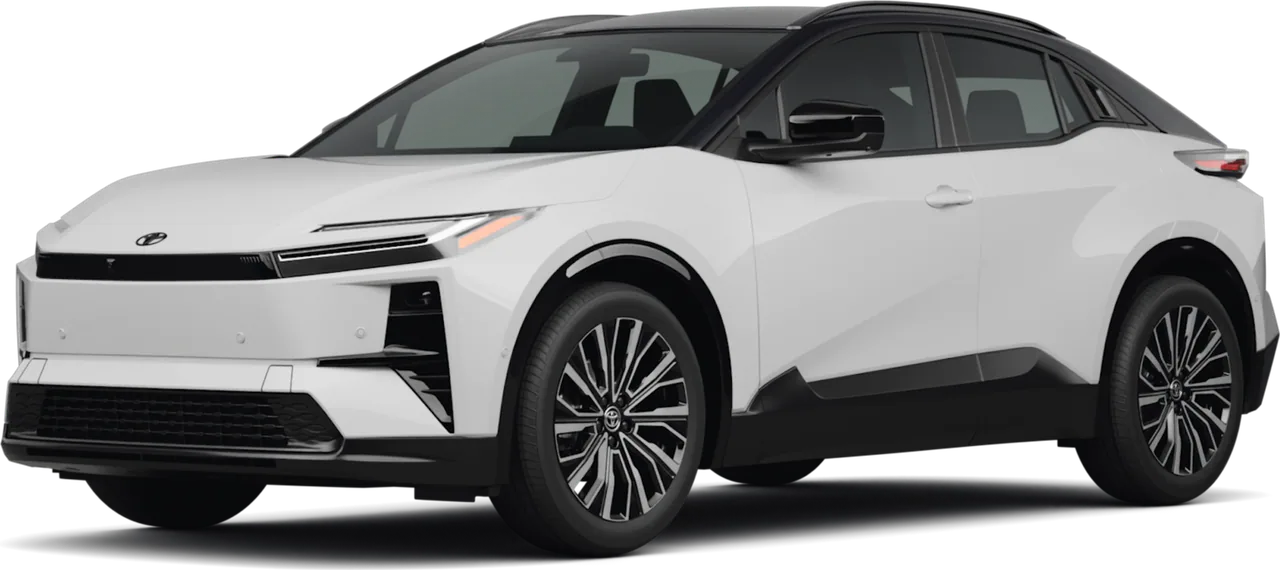
2026 Toyota C-HR AWD 18inch
Electric SUV · AWD
Based on battery health, build quality, owner data, EPA range, and market pricing
Above average for 2026 EV Compact SUVs (class avg 68 · top 5%)
Personalize this scoreIs a low score bad?
Last scanned 22 days ago
The 2026 Toyota C-HR AWD 18-inch has 287 miles of EPA range, 150 kW fast charging and a 70 kWh battery, and a worth-pursuing score, but only after a hard inspection and a fair price.
Score read
A 74/100 makes this worth inspecting. The useful split is build quality score at 97/100 versus owner feedback score at 51/100. On Reddit, owners keep flagging the same two issues: owner satisfaction and range. A good score still needs a battery report, service history, and a normal test drive.
Price context
Used examples are running around $36,652. Treat that as a budgeting floor, not a final price; pull a current KBB Fair Purchase or Edmunds True Market Value for this exact trim before negotiating.
Who this is for
✓ Good for
- ⏱ Daily commuter ≤50 mi/day, predictable charging
- ★ Weekend driver Performance, fun, low mileage
✗ Avoid if you are a
- $ Bargain hunter Best TCO, reliability + low depreciation
Gotchas
- Verify Owner feedback is the part to read carefully (51/100).
Mitigation Read the complaint themes and ask whether this VIN has already had those issues repaired.
Pre-purchase inspection
- 1 Compare the dashboard range estimate with the EPA 287-mile rating after a full charge.
- 2 Confirm how much of the 10-year/100,000-mile battery warranty remains and whether it transfers.
- 3 If road trips matter, run a short DC fast-charge session and watch whether speed tapers normally.
- 4 Read the complaint themes, not just the count, and ask the seller whether those issues have shown up on this VIN.
- 5 Review title, service history, tire condition, and charging-equipment records before final price.
No recall records in this scan That helps the shortlist, but it does not replace a VIN lookup, battery report, and service-history check.
Complaint context This scan found 0 NHTSA complaint records (0 per 10K VINs, low for any vehicle class). Read the themes below before treating the raw count as the verdict.
Price needs outside confirmation Current market pricing is incomplete, so MSRP should not be used as the deal signal. Compare KBB, J.D. Power, and live listings for this exact trim.
Pricing & Market Value
Score Breakdown
What matters most to you?
Drag the sliders to prioritize what you care about. Your TrimIndex Score recalculates instantly.
Vehicle Specifications
The federal $4,000 used-EV credit ended Sept 30, 2025.
But 10 states still run their own used-EV rebate programs — some up to $5,000. Pick your state to see what's available for this trim.
Source & disclaimer
Dealers make ~$3,575 on the average car loan.
After the price is set, the finance manager runs four plays to rebuild margin. Every buyer without a pre-approval is a target. Here's exactly what they run — and what stops each one.
78% of dealer loans carry a hidden +1.13% markup above what the lender actually charges. You never see it — it's buried in the contract. · CFPB
Dealer must match or beat your lender — they can't add margin invisibly. The markup play is dead on arrival.
Once you answer, they stretch the term to hit your number. Median result: $4K less off the price, 12 more months on the loan. · Industry avg
Financing is done. Only the sale price is on the table — and the dealer knows it.
Back-office F&I profit averages $1,975/vehicle, up 8.5% YoY. These products exist — but dealer markup is 4–10x what you'd pay elsewhere. · Dealership Guy
Dealer GAP runs $500–1K. Your insurer sells the same coverage for $100–250 over 5 years. Now you know.
"Your loan fell through — come re-sign." This pulls your APR up +5% on average. It's legal. It works because you've already driven the car home. · Ctr for Responsible Lending
A lender commitment letter means the deal is final. "Pending dealer approval" doesn't apply. You can't be yo-yo'd.
Margin handed to the dealer's finance department — for nothing.
Takes 2 minutes. No obligation to use it — but you'll walk in with all the leverage.
Pre-approval is a soft credit inquiry — no score impact. FICO treats all auto-loan hard pulls within 14 days as one, so you can still shop rates at the dealer.
NHTSA Recalls (0)
NHTSA Complaints (0 total · 0 per 10K US vehicles · low for any vehicle class)
No complaints filed with NHTSA for this vehicle.
What Owners Are Saying
"🔌🚗 1.5 months with a Toyota C-HR 220 PHEV – Real-world numbers and impressions Hi everyone, just wanted to share my experience after 1.5 months and 4,700 km (~2,920 miles) with my new Toyota C-HR 220 Plug-in Hybrid (PHEV). I’ve been tracking everything, so here are the actual numbers and some personal conclusions: 🔋 Electricity cost: €0.13 per kWh (taxes included) ⚡ Usable battery capacity: approx. 13.7 kWh 📈 Total energy charged: 333.51 kWh 🛣️ Total distance driven: 4,700 km ⚡🚗 Electric-only distance: 2,605 km ⛽ Overall fuel consumption: 3.22 L/100 km (~73 mpg US) 💰 I’ve saved around €100 in fuel compared to my previous car, which averaged 5.6 L/100 km. If you're switching from a more fuel-hungry car, the savings could be even greater. ⚙️ The electric mode is great — smooth, silent and efficient for urban driving, back roads, and even highways (as long as you’re not heavy on the pedal). ⚠️ The only drawback is that at 120 km/h (75 mph) or higher, the battery drains quickly. But in 90% of daily use, it’s incredibly efficient. 🧭 I also did a long road trip (highway + mountain roads), and the average fuel consumption was about 5.4 L/100 km, running on gas only. 🔌 In those situations, I completely forget about EV mode, since public chargers are both overpriced and scarce, especially in rural areas. It works like a regular hybrid there. 💸 In my case, the price difference between the PHEV and non-PHEV version was €3,000, so with these numbers, it’s easy to justify. 📉 If you qualify for Spain’s MOVES Plan (EV subsidy), it’s even more advantageous — but right now it’s completely stuck due to administrative overload, so don’t count on it short-term. ✅ Conclusions 🔹 Is a PHEV worth it over a regular hybrid (HEV)? ✔️ Yes — if you have access to cheap charging at home or work and plug in regularly. 🔹 Is a PHEV better than a full EV? ✔️ Yes, if it’s your main household car and you need flexibility for long trips without relying on public charging. Let me know if you’d like an update after a few more months. Happy to share more real-world usage!"
"Buying the new Toyota C-HR+, getting the home charger with it and Aviva insurance. Anything you’d do differently? So I’ve been reading this sub endlessly for a while now to learn more about EV’s and it has been incredibly valuable so thanks all; this has become my go-to for EV info. We’re in Cumbria so wanted a small SUV/Crossover size car and after test driving a few we’ve ordered the C-HR+ Design model (77kwh) as this seems the best size, range, etc for us. Toyota have a deal with new purchases to get the Hive home charger installed for £695 so we ordered that to and I saw a recommendation on EV insurance at Aviva and sure enough, they were the best price with the same add-ons so happy with that. I understand (from reading here) real-world range will be less due to our location, temps, hilly roads, etc but the C-HR+ should still hopefully keep at 300 or more so seems like the best fit for us. So looking this over - is there anything I’ve missed or you’d recommend I change?Thanks."
"Don't buy a Toyota EV. Plenty of people not happy with the BZ4X range and I don't think it will be any different with the CHR+. I'd for for an EC5 Aircross with the larger battery or the new GLB Electric."