All Vehicles
2024 Tesla Model X Trims Compared: Range, Price & Problems
Updated
2024 Tesla Model X: 2 trims compared. 326–335 mi EPA range, 8 recalls, 27 NHTSA complaints, top problem: Sudden braking with no hazard (19% of complaints).
Data:NHTSA through
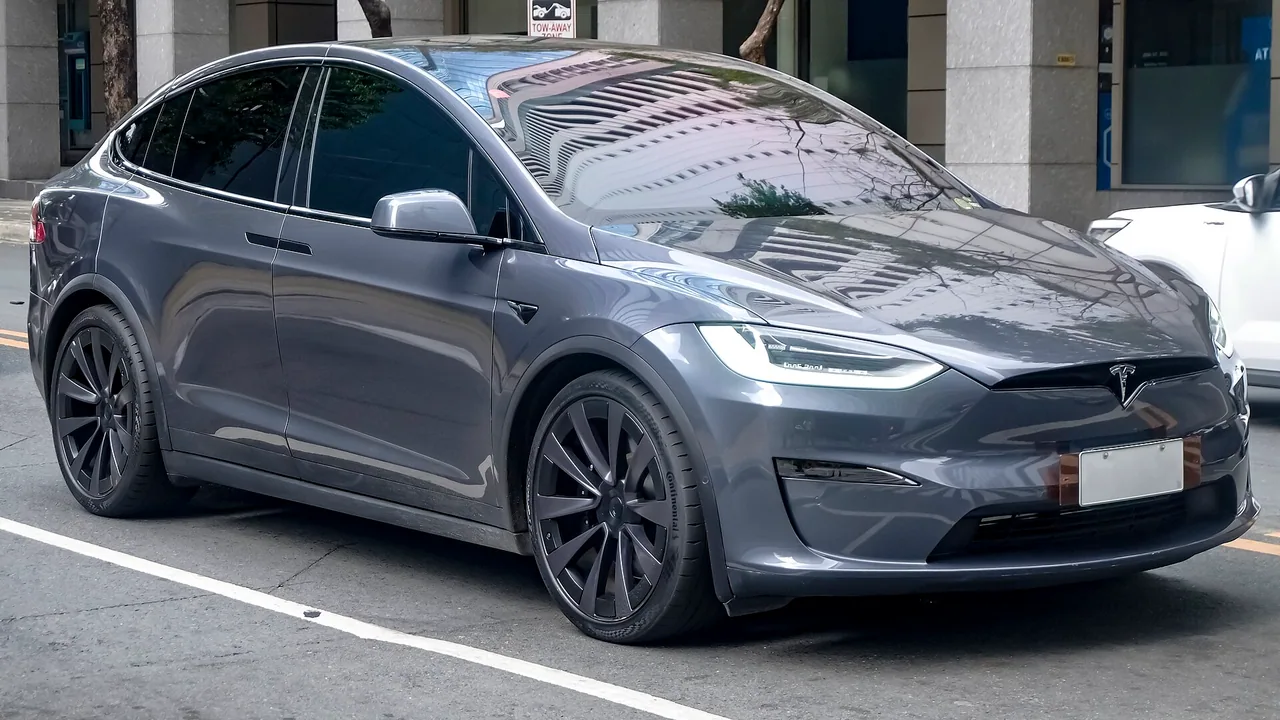

Compare the 2024 Tesla Model X trims
| Trim | TrimIndex score | Price new | Used price | Drive | EPA range | EPA energy use | Horsepower | 0–60 mph | DC fast-charge peak | Towing | Georgia tax value (2026 manual) |
|---|---|---|---|---|---|---|---|---|---|---|---|
| Plaid (20in wheels) | 70 | not stated | $86,300KBB, Nov 2026 | AWD | 326 mi | 34.5 kWh/100 mi | not stated | 2.5 s | 250 kW | 5,000 lb | $63,175 |
| Plaid (22in wheels) | 66 | not stated | $86,300KBB, Nov 2026 | AWD | 300 mi | 37.3 kWh/100 mi | not stated | 2.5 s | 250 kW | 3,500 lb | $63,175 |
| Model X | 69 | from $79,990starting price | $66,000KBB, Nov 2026 | AWD | 335 mi | 33.6 kWh/100 mi | 670 hp | 3.8 s | 250 kW | 5,000 lb | $51,600 |
Price new, horsepower, 0–60 mph, dc fast-charge peak and towing: Tesla, Inc., via the Internet Archive.
EPA range and EPA energy use: U.S. EPA and DOE, fueleconomy.gov.
Used price: the figure each trim page shows, with its source and the month collected.
Georgia tax value: the Georgia Department of Revenue's title-tax assessment value for each trim in its 2026 manual, one edition for every row; a state tax figure, not a sale price or market value.
TrimIndex score: out of 100.
Blank cells. Price new (2 rows): no manufacturer price for that trim on file; Horsepower (2 rows): no manufacturer document backs a rated figure.
What differs between the 2024 Tesla Model X trims
Compared with the 2024 Model X Plaid (20in wheels), the Model X has a used price on file $20,300 lower (KBB, Nov 2026), with a 0–60 mph claim 1.3 s slower.
Which 2024 Tesla Model X trim for what
- Quickest 0–60 mph (manufacturer claims): the 2024 Model X Plaid (20in wheels), 2.5 seconds; next, the Model X has 3.8 seconds.
- Lowest used price on file: the 2024 Model X, $66,000; next, the Plaid (20in wheels) has $86,300.
NHTSA Recalls (8)
- NHTSA lists 8 recall campaigns for the 2024 Tesla Model X, filed between Nov 2023 and Mar 2025.
- How they are fixed, per the filings: 4 by a software update (all can install over the air), 3 by work on the car and 1 by both a software update and work on the car.
Source: NHTSA recall filings for the 2024 Tesla Model X, data through Nov 22, 2026. Why the VIN decides
- Filed Mar 2025
An air bag with the incorrect horn pad may have been installed, preventing the horn from sounding.
Campaign #25V172000 · Part (NHTSA): air bags- What happens:
- An inoperative horn may prevent the driver from alerting other drivers, increasing the risk of a crash.
- The fix
- Free fix: work on the car by Tesla Service Tesla service will inspect and install an air bag with the correct horn pad as necessary, free of charge.
- Covers:
- certain 2021-2024 Model S and 2021-2025 Model X vehicles.
NHTSA lists 91 vehicles in this campaign (all models it covers).
Check VIN status at NHTSA.gov - Filed Jan 2025
The computer circuit board may short, resulting in the loss of the rearview camera image.
Campaign #25V002000 · Part (NHTSA): back over prevention › software- What happens:
- A rearview camera that does not display an image reduces the driver's rear view, increasing the risk of a crash.
- The fix
- Free fix: software update (it can install over the air) plus work on the car Tesla released an over-the-air (OTA) software update, free of charge. Tesla will also identify any vehicles that experienced a circuit board failure, or stress that may lead to a circuit board failure, and replace the affected computers, free of charge.
- Covers:
- certain 2024-2025 Model 3, Model S, 2023-2025 Model X, and Model Y vehicles.
- Federal standard not met:
- 111 (Rear Visibility).
NHTSA lists 239,382 vehicles in this campaign (all models it covers).
Check VIN status at NHTSA.gov - Filed Dec 2024
The driver's air bag could tear during deployment.
Campaign #24V967000 · Part (NHTSA): air bags › frontal › driver side › cushion- What happens:
- A torn air bag may not adequately protect an occupant in a crash, increasing the risk of injury.
- The fix
- Free fix: work on the car by Tesla Service Tesla service will replace the air bag assembly, free of charge.
- Covers:
- certain 2021-2025 Model S and Model X vehicles.
- Federal standard not met:
- 208 (Occupant Crash Protection) and 212 (Windshield Mounting).
NHTSA lists 487 vehicles in this campaign (all models it covers).
Check VIN status at NHTSA.gov - Filed Dec 2024
The parking lights and low beam headlights may flicker.
Campaign #24V904000 · Part (NHTSA): exterior lighting › headlights- What happens:
- Flickering headlights or parking lights may not suffciently illuminate the roadway, increasing the risk of a crash.
- The fix
- Free fix: software update over the air Tesla released an over-the-air (OTA) software update, free of charge. All vehicles were updated by September 17, 2024.
- Covers:
- certain 2024 Model X vehicles.
- Federal standard not met:
- 108 (Lamps, Reflective Devices, and Associated Equipment).
NHTSA lists 25 vehicles in this campaign (all models it covers).
Check VIN status at NHTSA.gov - Filed Jul 2024
The hood latch assembly may fail to detect an unlatched hood condition after the hood has been opened.
Campaign #24V554000 · Part (NHTSA): electrical system › software- What happens:
- An unlatched hood can fully open, obstructing the driver's view and increasing the risk of a crash.
- The fix
- Free fix: software update over the air Tesla has released an over-the-air (OTA) software update, free of charge.
- Covers:
- certain 2021-2024 Model 3, Model S, Model X, and 2020-2024 Model Y vehicles.
NHTSA lists 1,849,638 vehicles in this campaign (all models it covers).
Check VIN status at NHTSA.gov - Filed May 2024
In the event of an unbelted driver, the seat belt warning light and audible chime may not activate as intended.
Campaign #24V376000 · Part (NHTSA): seat belts › front › warning light/devices- What happens:
- A seat belt warning system that fails to alert occupants of an unbelted seat belt can increase the risk of injury during a crash.
- The fix
- Free fix: software update over the air Tesla will release an over-the-air (OTA) software update.
- Covers:
- certain 2012-2024 Model S, 2015-2024 Model X, 2017-2023 Model 3, and 2020-2023 Model Y vehicles.
- Federal standard not met:
- 208 (Occupant Crash Protection).
NHTSA lists 125,233 vehicles in this campaign (all models it covers).
Check VIN status at NHTSA.gov - Filed Jan 2024
An incorrect font size is displayed on the instrument panel for the Brake, Park, and Antilock Brake System (ABS) warning lights.
Campaign #24V051000 · Part (NHTSA): electrical system › instrument cluster/panel- What happens:
- Warning lights with a smaller font size can make critical safety information on the instrument panel difficult to read, increasing the risk of a crash.
- The fix
- Free fix: software update over the air Tesla began releasing an over-the-air (OTA) software update, free of charge.
- Covers:
- certain 2012-2023 Model S, 2016-2024 Model X, 2017-2023 Model 3, 2019-2024 Model Y, and 2024 Cybertruck vehicles.
- Federal standard not met:
- 105 (Hydraulic and Electric Brake Systems) and 135 (Light Vehicle Brake Systems).
NHTSA lists 2,193,869 vehicles in this campaign (all models it covers).
Check VIN status at NHTSA.gov - Filed Nov 2023
An incorrect air bag may have been installed when the steering yoke or round steering wheel was replaced with a different style of yoke or steering wheel.
Campaign #23V743000 · Part (NHTSA): steering › steering wheel/handle bar- What happens:
- An air bag that is not designed to function with the replacement steering yoke or wheel may deploy incorrectly, increasing the risk of injury during a crash.
- The fix
- Free fix: work on the car by Tesla Service Tesla Service will inspect and replace the driver air bag as necessary, free of charge.
- Covers:
- certain 2021-2024 Model S and Model X vehicles.
NHTSA lists 194 vehicles in this campaign (all models it covers).
Check VIN status at NHTSA.gov
NHTSA Investigations (4 open, 2 closed)
NHTSA has 4 open investigations covering the 2024 Tesla Model X (NHTSA investigations file of Nov 19, 2026).
What these kinds of action mean
- OpenEngineering analysis EA26002, opened Mar 18, 2026
FSD Collisions in Reduced Roadway Visibility Conditions
What NHTSA says it is examining: The Office of Defects Investigation (ODI) is opening this Engineering Analysis to evaluate Tesla’s Full Self Driving Beta and Full Self Driving (Supervised) (collectively, FSD) degradation detection system.
Model years NHTSA lists for this model in the action: 2016-2026.
- OpenPreliminary evaluation PE25012, opened Oct 7, 2025
Traffic safety violations while Full Self Driving ("FSD") is engaged
What NHTSA says it is examining: The Office of Defects Investigation (“ODI”) is opening this Preliminary Evaluation (PE) to assess the scope, frequency, and potential safety consequences of FSD executing driving maneuvers that constitute traffic safety violations.
Model years NHTSA lists for this model in the action: 2016-2025.
- OpenAudit query AQ25002, opened Aug 20, 2025
Compliance with Standing General Order 2021-01 Reporting Requirements
What NHTSA says it is examining: The Office of Defects Investigation (“ODI”) has identified numerous incident reports submitted by Tesla, Inc. (“Tesla”) in response to Standing General Order 2021-01 (the “SGO”), in which the reported crashes occurred several months or more before the dates of the reports.
Model years NHTSA lists for this model in the action: 2016-2025.
- OpenRecall query RQ24009, opened Apr 25, 2024
Recall 23V838 Remedy Effectiveness
What NHTSA says it is examining: The Office of Defects Investigation (ODI) is opening a Recall Query to assess the remedy adequacy of Recall 23V838.
Model years NHTSA lists for this model in the action: 2016-2024.
NHTSA has closed 2 actions on the 2024 Tesla Model X: 2 preliminary evaluations, opened between Oct 2024 and Jan 2025.
Show the 2 closed actions
- Actually Smart Summon sessions resulting in low-speed impactsPreliminary evaluation PE24033, opened Jan 6, 2025, closed Apr 3, 2026
- FSD Collisions in Reduced Roadway Visibility ConditionsPreliminary evaluation PE24031, opened Oct 17, 2024, closed Mar 18, 2026
Source: NHTSA Office of Defects Investigation, investigations file, records through Nov 19, 2026; an open investigation is not a finding of a defect in the 2024 Tesla Model X.
NHTSA Complaints (27 total)
NHTSA lists 8 recall campaigns for the 2024 Tesla Model X; 5 of them name an over-the-air software update as the fix. Owners have filed 27 complaints with NHTSA; the largest part group is Forward collision avoidance (9). Of all 27, 2 report a crash.
What owners report most
TrimIndex grouped the 27 complaints owners filed with NHTSA on the 2024 Tesla Model X (every trim; NHTSA files complaints by model year, not trim) into problem themes on Nov 16, 2026: 17 of them fall in the 5 themes below. How themes are made and checked
-
Sudden braking with no hazard
5 of 27 complaints (19%): With cruise control or self-driving engaged, the car brakes hard or stops abruptly with nothing in the way, leaving following traffic close behind.
“the vehicle has either driven off the road or abruptly slammed on the brakes without warning”
NHTSA complaint 11693108 “The vehicle will abruptly try to stop, or slow down aby 5-10 MPH”
NHTSA complaint 11644347 -
Airbag or restraint warnings
3 of 27 complaints (11%): A restraint system fault or passenger airbag warning appears, or the passenger airbag shows off with an adult seated.
“Passenger side airbag is always OFF even when there is a passenger seated with their seat belt on.”
NHTSA complaint 11629997 “The vehicle consistently displays the message "Rear right safety restraint system fault" on the dashboard since its delivery in January 2024.”
NHTSA complaint 11581428 -
Self-driving feedback prompt blocks screen
3 of 27 complaints (11%): After the driver takes over from self-driving, a feedback pop-up covers part of the center screen and stays until the driver taps an answer.
“It does not clear on its own while driving; it stays until the driver taps an option or shifts into Park.”
NHTSA complaint 11771102 “once full self-driving is disengaged a pop-up menu shows up at the main part of the screen requesting a feedback why full self-driving was disengaged”
NHTSA complaint 11735665 -
Car moves on its own
2 of 27 complaints (7%): At low speed in reverse or while backing out, the car accelerates or starts moving without pedal input.
Owners reported a crash in 1 of the 2 complaints.
“when my husband backed the vehicle out of the garage slowly, the vehicle suddenly accelerated and it hit the stone column”
NHTSA complaint 11616937 “When the vehicle is placed in reverse with the steering wheel turned to full lock, it unexpectedly initiates self-movement without any driver input.”
NHTSA complaint 11647480
27 complaints filed with NHTSA for the 2024 Tesla Model X, between Mar 2024 and Oct 2026.
Parts named most often
| Part | Complaints | Share |
|---|---|---|
| Forward collision avoidance including automatic emergency braking (6) and adaptive cruise control (5) | 9 | 33% |
| Electrical system (other) | 4 | 15% |
| Steering | 3 | 11% |
| Body and structure including body (3) | 3 | 11% |
| Suspension | 3 | 11% |
Share of all 27 complaints; one complaint can name more than one part, so shares add up to more than 100%. 6 complaints name no specific part.
Owners reported a crash in 2 of the 27 complaints. How these fields are filled
Complaints by year filed
| Year filed | Complaints |
|---|---|
| 2024 | 6 |
| 2025 | 10 |
| 2026 (to Nov 22) | 11 |
Source: NHTSA owner complaints filed on every 2024 Tesla Model X (NHTSA files them by model year, not trim), data through Nov 22, 2026.
The 25 most severe, then newest, of 27
- Severity 4 of 5.
On XXX, at approximately 3:30 PM while using FSD (Supervised) on software 2026.21.6, my Tesla Model X came to a sudden complete stop in the middle of a busy four-lane intersection. I had to intervene.
Show the rest
The FSD feedback prompt appeared; I selected Critical. Approximately one mile later, while programming a destination, FSD pulled over unsafely on a busy multi-lane road with barely enough room for 50 mph traffic. I intervened again and selected Critical on the prompt. Neither event appears in the Dashcam Viewer (only Sentry parking clips visible). These continue a pattern. Previously, while driving from [XXX] to [XXX], the car jumped across freeway lanes unsafely. I reported it via the Tesla app and to Cathedral City Service. Technicians lacked diagnostic equipment, said they would escalate to the FSD team for research, and promised to realign the front cameras on a return visit. Months later: no follow-up and cameras still cosmetically misaligned. Camera Calibration menu only shows Clear option (I did not clear it). I have submitted a Service request and emailed Tesla requesting internal logs/telemetry and full escalation. Filing this for an independent record. INFORMATION REDACTED PURSUANT TO THE FREEDOM OF INFORMATION ACT (FOIA), 5 U.S.C. 552(B)(6)
NHTSA ODI #11758107 - Severity 4 of 5.Brakes · Steering · Forward collision avoidance
On XXX at approximately 465 miles, multiple critical safety systems simultaneously failed on my 2024 Tesla Model X (VIN: [XXX]).
Show the rest
Dashboard warnings indicated that ABS, stability control, traction control, steering assist, and automatic emergency braking were all simultaneously disabled. The vehicle was taken to Tesla Service immediately. Tesla diagnosed the issue as a faulty wheel speed sensor and performed a replacement (RO# XXX). This simultaneous disabling of five critical safety systems on a vehicle with only 465 miles is a serious safety defect. Additionally, on XXX at approximately 21,180 miles, a passenger airbag warning light illuminated requiring service. This was resolved and addressed by slight moisture on son's shorts triggering the alert but unsure why this would cause such sensitivity. The vehicle has required 12 service visits since delivery in November 2024 for various recurring safety and mechanical issues. INFORMATION REDACTED PURSUANT TO THE FREEDOM OF INFORMATION ACT (FOIA), 5 U.S.C. 552(B)(6)
NHTSA ODI #11753633 - Severity 4 of 5.
I would like to report a potential safety issue regarding Tesla Full Self-Driving (FSD), specifically version 14.3.2.
Show the rest
Following any driver intervention (such as braking or steering override), the system presents a prompt asking “Why did you intervene?” with selectable options (e.g., Navigation, Discomfort, Preference, Critical) or voice input. In my experience, this prompt does not automatically dismiss and requires manual interaction with the touchscreen to clear. This design creates a safety concern because: - It introduces a mandatory driver interaction immediately after a disengagement event. - It diverts driver attention away from the road during a potentially critical moment. - It may encourage rushed or inattentive responses just to clear the interface. Driver intervention moments are often associated with complex or unsafe driving situations, where full attention is essential. Requiring touchscreen interaction at that time may increase the risk of distraction-related incidents. I believe this behavior could represent a human-machine interface design issue that impacts driver safety. Vehicle: Tesla [Model] Software Version: FSD 14.3.2 Frequency: Occurs consistently after interventions
NHTSA ODI #11735945 - Severity 4 of 5.Steering · Forward collision avoidance
Vehicle GPS self driving is malfunctioning. GPS shows the route driving through houses and buildings The assisted self driving is extremely unsafe to use and the same goes for the
Show the rest
GPS guided navigation The GPS is untrustworthy giving multiple unsafe routes.
NHTSA ODI #11730830 - Severity 4 of 5.Electrical system (other) · Steering · Forward collision avoidance
I am writing to express my deep concern regarding ongoing safety and service issues with my 2024 Tesla Model X.
Show the rest
This is the third Tesla vehicle we’ve owned, and while our previous two vehicles performed excellently, this one has presented serious and recurring problems with the Full Self-Driving (FSD) system. Since the second service visit, we have experienced four separate incidents in which the vehicle has either driven off the road or abruptly slammed on the brakes without warning. Despite two prior service appointments at the Tesla Service Center in Sarasota, FL, these issues remain unresolved. We also scheduled a third appointment, which Tesla later cancelled.
NHTSA ODI #11693108 - Severity 4 of 5.Crash
i was in full self driving mode. the car wanted to turn left but i thought it was going in the wrong direction so i tried to continue straight by turning the wheel to the right
Show the rest
forcefully but the car would not let me take over and i crashed into a guard rail. when i tried to brake it was not able to stop soon enough, i have a dash cam footage. i have taken over the this way numerous times and it usually does not require much force to do so, this time it simply would not allow me to control the wheel. no one was hurt other that a guard rail. the car was totaled by insurance company. the police assisted me but i never received a police report. no pictures to share, just a dashcam video but i dont know if that would be helpful since there isn't a way to upload it that i can see. [XXX] INFORMATION REDACTED PURSUANT TO THE FREEDOM OF INFORMATION ACT (FOIA), 5 U.S.C. 552(B)(6)
NHTSA ODI #11682400 - Severity 4 of 5.Air bags · Seat belts
1. Passenger (next to driver) side no-belt warning is not working. Seat belt warning is not shown even when the passenger (adult) does not wear belt.
Show the rest
It is consistently reproducible even when the vehicle is at highway speeds. 2. Passenger side airbag is always OFF even when there is a passenger seated with their seat belt on. I purchased this vehicle in April'2024 and have been consistently having sensor issues. I took the vehicle to a Tesla service center but they did not do repairs. The seat belt and passenger side airbag issue has started very recently. We noticed it 2-3 days back and have reported it to Tesla customer service center via chat message in Tesla app but they have not responded. I called Tesla emergency road number and reported the same but they were not able to help. Hence I am reporting to NHTSA as a last resort to see if the major security issue can be fixed.
NHTSA ODI #11629997 - Severity 4 of 5.Brakes · Speed control · Forward collision avoidance Crash
On July 29, 2024, when my husband backed the vehicle out of the garage slowly, the vehicle suddenly accelerated and it hit the stone column causing a big damage to the car.
Show the rest
I believe the pedal speed control and emergency brake have problems. When I reported to Tesla, they said the vehicle was not at fault. They said the issue had been resolved remotely by the engineer and cancelled my service appointment. When I asked for the engineer report, Tesla rep told me to download the data report. After I downloaded the data report, it shows no data 2 hours before and after the time of the incident. When I tried to retrieve the video on the replay function in the vehicle, the video was not there anymore. Fortunately, my husband recorded the video on his phone and I have a copy of the video. I feel very disappointed and frustrated with how Tesla handled the issue. If they are not at fault, how come the data report and video are not available? I filed a claim under my auto insurance policy and got the vehicle fixed. This sudden unintended acceleration happened to me back in June when the vehicle accelerated by itself to 41mph. My daughter, who was sitting next to me in the front passenger seat, saw my foot was in the air but the vehicle kept moving at 41mph. We were so shocked and I had to use both feet to step on the brake to stop the vehicle. Tesla eventually replaced the steering column control in the beginning of July. Then, on July 29, the sudden acceleration happened again to my husband. This safety issue needs to be addressed by Tesla more seriously. I should at least get a written explanation of what happened and not just a phone call telling me the vehicle was not at fault. Since the damage to vehicle is fixed now, we would drive the vehicle more often. I don't want this sudden unintended acceleration to happen again, hitting something or someone on the road!
NHTSA ODI #11616937 - Severity 4 of 5.Air bags · Seat belts · Seats
The vehicle consistently displays the message "Rear right safety restraint system fault" on the dashboard since its delivery in January 2024.
Show the rest
This indicates a potential malfunction in the airbag or seatbelt system, posing a safety risk to passengers occupying the rear right seat while the vehicle is in operation. Despite multiple inspections and diagnoses by Tesla, the dealership has attributed the issue to a firmware or software glitch without providing a definitive solution. Consequently, the warning message persists on a daily basis, necessitating urgent resolution to make sure the safety and functionality of the vehicle's safety systems.
NHTSA ODI #11581428 - Severity 3 of 5.Electrical system (other)
Since a 2026 over-the-air software update, every time I disengage Tesla Full Self-Driving (Supervised) while driving, on any road and at any speed, the center touchscreen shows a
Show the rest
large pop-up titled "Why did you intervene?" with four buttons (Navigation, Parking, Critical, Other) and a voice-message option. It covers about a third of the display, including navigation, media controls and, during parking, the camera view. It does not clear on its own while driving; it stays until the driver taps an option or shifts into Park. Photos attached. Disengagements happen at the most demanding moments: correcting the system, avoiding a hazard, merging or parking. This prompt draws the driver's eyes and hand to the touchscreen at exactly those moments, on every disengagement and several times per drive. I believe this creates a foreseeable visual-manual distraction risk and conflicts with NHTSA's Visual-Manual Driver Distraction Guidelines. There is no setting to disable this prompt; the only way to avoid it is to stop using FSD, which I paid for. The car is collecting training feedback from drivers in real time at the expense of attention to the road. I request that NHTSA review this and that Tesla make the prompt dismissible, defer it until the vehicle is parked, or make it optional. Reproducible on every FSD disengagement; not inspected by a dealer. Vehicle software 2026.27.11, FSD (Supervised) v14.3.10.
NHTSA ODI #11771102
Show 15 more complaints
- Severity 3 of 5.Electrical system (other)
On 7/29/2026, 2:45 PM PST, I tapped the in-car myQ interface to send an "Open" command.
Show the rest
Due to network latency/ connection drops in the Tesla infotainment system, there was a significant delay before the open command executed. After it finally opened, I proceeded to back out in Reverse. However, due to buffering/retry logic during the network reconnect, the system unexpectedly transmitted a follow-up "Close" command without any driver input. Because this automated ghost command executed while the vehicle was actively backing out, the overhead garage door unexpectedly began closing, striking the car and shattering the left Falcon Wing door glass. Safety Concern: The infotainment software suffers from a critical retry/buffering flaw where latent network API payloads execute out of sequence or trigger unintended secondary commands after initial connection drops. Transmitting an unprompted "Close" signal to an overhead garage door while a vehicle is actively moving in Reverse creates a severe collision hazard and safety risk for occupants and bystanders.
NHTSA ODI #11754055 - Severity 3 of 5.Forward collision avoidance · Lane keeping and blind-spot systems
once full self-driving is disengaged a pop-up menu shows up at the main part of the screen requesting a feedback why full self-driving was disengaged you cannot dismiss the
Show the rest
questionnaire easily without being distracted during the driving extremely dangerous The only way to dismiss the compulsory questionnaire is to make a selection of 1 option or double click on a microphone button on the steering wheel extremely distractive and requires not to look at the road just at the moment you disengage full self-driving there is no option to dismiss it Tesla is forcing you to answer it
NHTSA ODI #11735665 - Severity 3 of 5.Drive unit
Tesla remotely blocks a car powertrain without warning if a service invoice wasn’t paid before leaving a service center.
Show the rest
This poses a safety risk because the car might unexpectedly become non-driving, such as after returning from a hike with young kids in a remote area, without water, food, or medications. To reproduce this issue, follow these steps: 1. Leave a Tesla service before a service or part is charged to the card on file (this can happen for various reasons). 2. Park the car in an underground parking garage or a remote area with no cellular connectivity. 3. Attempt to return home. The result is that the car will be blocked by an unknown PIN, even if the invoice was automatically charged to the card on file while driving. Without Internet connectivity, it’s impossible to work around the PIN. The car has be towed to an area with cellular connectivity to resolve the issue.
NHTSA ODI #11691987 - Severity 3 of 5.Forward collision avoidance
I am reporting a potential safety issue with my Tesla Model X. When the vehicle is placed in reverse with the steering wheel turned to full lock, it unexpectedly initiates
Show the rest
self-movement without any driver input. I raised this issue with Tesla Service, and they responded with the following statement: "We are aware of this and [it is] currently a known software characteristic at this time. It is under investigation and to be resolved with a future software update." Tesla has acknowledged this issue but has not provided a timeline for a fix. Safety Concerns: This unexpected movement can pose a serious safety risk in environments where precise control is needed, such as driveways, parking lots, and tight spaces. It could indicate a malfunction in the vehicle’s drive-by-wire system, creating potential hazards for drivers and pedestrians. There is no way to predict or prevent this movement without significant driver intervention, increasing the risk of collisions or unintended acceleration incidents. Request for Investigation: Since Tesla has already acknowledged this as a known issue, I urge the NHTSA to investigate its potential safety risks. If this is affecting multiple vehicles, Tesla should be required to release a timely fix rather than leaving owners waiting for an undefined future software update.
NHTSA ODI #11647480 - Severity 3 of 5.Forward collision avoidance
Since February 20th, I have begun keeping a log of these occurrences. Below is a summary: [XXX]: 2-3 occurrences on [XXX] (from Estes Park to Fort Collins, CO) and 2 occurrences on [XXX] northbound.
Show the rest
[XXX]: 2-3 occurrences on [XXX] southbound. [XXX]: 1 occurrence on [XXX] southbound and 1 near the [XXX] exit in Colorado. [XXX]: 2-3 occurrences on [XXX] southbound. [XXX]: 2 occurrences on [XXX] southbound, on the morning of my service appointment to drop the vehicle off at the Tesla Service Center in Loveland, CO. [XXX]: 2 occurrences on [XXX] northbound, on the way home from the service appointment. each time the car abruptly slows down by 10-15 miles per hours, unless I intervene and stop using this feature. I only use the cruise control feature of the car. There have been several close calls with other motorists on the road. INFORMATION REDACTED PURSUANT TO THE FREEDOM OF INFORMATION ACT (FOIA), 5 U.S.C. 552(B)(6)
NHTSA ODI #11645837 - Severity 3 of 5.Forward collision avoidance
Phantom Breaking and vehicle slow down events occur near daily when using the highway when adaptive cruise control is engaged. The vehicle will abruptly try to stop, or slow down aby 5-10 MPH.
Show the rest
This has caused several close calls with other drivers on the highways. Date of the incident is the latest. In the last two weeks prior to the incident, it has occurred at least 6-10 times.
NHTSA ODI #11644347 - Severity 3 of 5.
I want to bring to your attention a safety issue on the 2024 Tesla Model X. The turn signal buttons are a safety hazard. 1.
Show the rest
I have found myself pressing the wrong turn signal button and was nearly in an accident more than once. That’s because the turn signals are placed too close together (see attachment). You have to take your eyes off the road and look down to make sure you are pressing the correct turn signal button. It’s too easy to press the wrong button. 2. At night, it’s hard to read the turn signal buttons as they are not illuminated. This is not only a safety hazard but bad design. Surely Tesla could have put the the left turn signal button on the left side of the steering wheel and the right turn signal button on the right side of the steering wheel. It just makes common sense. 3. It’s even more of a hazard when you are on a roundabout and you want to exit the roundabout. The turn signal buttons are at the bottom of the steering wheel making it very difficult to select the correct turn signal button when you want to safely exit the roundabout (see second attachment). The only real safe solution is for Tesla to revert to the previous turn signals on a stalk, As you are probably aware, with a stalk you select the turn signal with one finger while keeping your eyes on the road. Up for the left turn signal and down for the right turn signal. Very simple, effective and safe. IMHO this hazardous situation warrants a recall to install the previous stalk turn signal device. There is a flood of messages on social media about this safety problem. Nobody likes the new system. I have read online that Tesla's response is that with self-driving you won't need to worry about turn signals. Not every Tesla owner wants or likes self-driving, myself included. This is just a lame excuse. I hope you will do something about the unsafe situation.
NHTSA ODI #11635007 - Severity 3 of 5.
Tesla has replaced the stalk, normally used for turn signals, into touch screen buttons on the steering wheel.
Show the rest
It is very difficult to use these buttons to switch on the turn signal, especially if the steering is not pointing absolutely straight. In other words, if the steering is turned at even a small angle, it becomes almost impossible to press the correct touch screen button without looking down and therefore compromising attention to the road. This can be dangerous, especially at higher speeds, when a fraction of a second delay in response could result in an accident. To add to this problem, often times, when sunlight is coming in at a specific angle, the touch screen buttons are not even visible! These design issues are increasing the chances of a mishap when a turn signal is needed. It is also causing a driver behavior change where drivers are not giving the turn signal, when it is needed. All this is resulting in increased risk which is not good. Tesla needs to provide some type of fix for this issue as soon as possible. This could be in the form of putting the turn signal stalk back in, or at least, ensuring that the left and right turn signals are on different sides of the steering instead of one below the other. They also need to change the lighting on the buttons so that they don't disappear in certain types of daytime light situations. They should also make them protrude out slightly so that they can be felt with the fingers instead of being just touch screen buttons dependent entirely on visibility.
NHTSA ODI #11597451 - Severity 2 of 5.Body and structure
Both Garnish - Fender - Front - LH Right side and Left side come loose when driving in rain.
Show the rest
The force of wheels pushing rain water on the fender garnish causes both the left and right fender garnish 4 push clips to come loose. When this fender garnish breaks and flies off it could hit a pedestrian, another car on the road or the car it is installed on causing an accident
NHTSA ODI #11741158 - Severity 2 of 5.Body and structure
COMPONENT: Rear right falcon-wing door electronic control system. Door becomes stuck in a partially closed position and cannot be opened from inside or outside.
Show the rest
Vehicle and component are available for inspection. SAFETY RISK: Falcon-wing doors have NO exterior mechanical release accessible to occupants when the electronic system fails. An occupant of the rear right seat can be trapped inside the vehicle. This creates a foreseeable risk of serious injury or death in any emergency requiring rapid egress: collision, fire (including thermal-runaway events documented across the lithium-ion EV fleet), submersion, or smoke inhalation. The risk is especially severe for child passengers using this seating position. CONFIRMED BY DEALER: Yes. Tesla Service Aliso Viejo and Tesla Collision Aliso Viejo (CA) inspected and attempted repair on at least 5 separate occasions between October 2025 and April 2026. Tesla represented in writing each time that the issue was resolved. The defect has recurred after every repair attempt. As of May 2026 the door remains unsafe. INSPECTED BY: Tesla service technicians only. No police, insurance, or independent inspection. WARNING SYMPTOMS / TIMING: The defect began in September 2025. No prior warning lamps or messages. The door operated normally for the preceding 12 months. Tesla initially attributed the failure to a minor cosmetic scratch sustained 12 months earlier — a theory inconsistent with the timeline, since the scratch existed during 12 months of normal door operation. Recurrence after 5+ failed repair attempts confirms the defect is electronic in nature, not cosmetic.
NHTSA ODI #11736437 - Severity 2 of 5.Body and structure
1) Yes, upon opening the falcon door there is water flooding down 2) Yes 3) Yes 4) No
NHTSA ODI #11728896 - Severity 2 of 5.
It was a windy day I was driving to work I was only driving max 14 mph and there were leaves flying due to the wind and without any warning the phantom break came on and my car just randomly stopped.
Show the rest
It was in my neighborhood at 1830. It left me traumatized for few minutes because there was no need for the car to randomly stop like it did. The outcome could have been an injury if I was on the freeway or if a car was behind me. Till this day ever time I drive it i wonder if I will have the same incident again.
NHTSA ODI #11710192 - Severity 2 of 5.Battery and propulsion system · Suspension · Speed control
The vehicle experienced serious drive control failures on three separate dates: September 21, 2024; October 2, 2024; and July 26, 2025.
Show the rest
On each occasion, acceleration was either severely delayed or completely unresponsive, and the vehicle rolled backward when attempting to move forward on an incline. The following warnings appeared on the dashboard: “Stability Control Disabled,” ESC (Electronic Stability Control) warning light, and Air Suspension System warning. These symptoms occurred both while stationary and while driving. The vehicle was brought to Tesla service centers twice—on October 10, 2024, and September 2, 2025. On both occasions, Tesla stated that the issue could not be reproduced and returned the vehicle without performing any repairs. During the second visit, Tesla performed a $275 wheel alignment adjustment. The service report noted that the warning lights “may be restored on next drive.” I was verbally told that adjusting the alignment might help identify the root cause, but Tesla never explained how this adjustment was related to the actual symptoms. After performing the alignment, I was simply notified that the vehicle was ready for pickup. This kind of propulsion failure and rollback on inclines presents a serious safety risk to the driver, passengers, and other vehicles on the road. The issue remains unresolved and could occur again at any time without warning.
NHTSA ODI #11685764 - Severity 2 of 5.Suspension · Forward collision avoidance
Purchased this vehicle new from Tesla on March 29, 2024. As I got home I hear a pop sound come from underneath the car and the abs warning light came on.
Show the rest
The vehicle lost some of the functions like regenerative breaking and cruise control. The suspension was also inoperable. I brought the car in on the first availible service date to get the repair done which took a few days. After repair was completed I went back to pick the car up only to have the same warnings appear on the odometer and lost of functionality again 20 minutes into driving home. I contacted Tesla and they gave me another appointment at a different service center. I then brought the car to the other service center and they corrected the ABS and other warning light issue. However, I been experiencing vibration on highways when breaking and regenerative breaking. Since the beginning of ownership. I mentioned it to them but the told me vibrations can be normal with these cars so I endured it ever since until it felt worst after a while. I brought the car in again and they diagnosed it. They recommended changing the rear rotors and brake pads. After picking the car up its still doing the same thing. This costed me $1200 out of pocket. I brought the car in for front end noises and they changed parts under warranty. The noises was gone after the service but a week later I heard the noises again and it worsened. Now they are refusing further repairs and recommended that I take the car to a auto body repair shop.
NHTSA ODI #11664122 - Severity 2 of 5.Suspension · Wheels
The tire blow up on the freeway while driving with no impact, collision or any warning or any external factors, it’s very well documented all over the internet that Model X Tesla
Show the rest
have serious Tire problems associated with faulty tire pressure system TPMS and in accurate tire reading as well with a car alignment that don’t compensate or adjust for the air suspension height changes that is available within the car settings and that causes a rapid and dangerous uneven tire wear that could lead to a tire failure on the road while driving. Tesla just recently recalling 700,000 cars with tire pressure issues and my car is effected as well because we never received any warning before the blowout. We did inspect the tire and documented everting showing no evidence of any that went through the tire to cause it go flat, the car is 8 month old and everything is fairly new and we should never have to deal with such and event that almost got us killed on the freeway, also since we were forced to exit the freeway for our safety driving on a flat tire that did cause a serious damages to the tire and vehicle with no spare wheel available to get it replaced on the spot to prevent any further damages, the car is not safe to be driven with serious Tire Pressure and bad alignment that comes from the factory that don’t match the suspension profile selected by the user that puts lots of unnecessary stress on the tire that causes a serious dangerous event to happen anytime. Tesla is refusing to take any responsibility for this issue even though it’s very well documented and we end up with a $4500 bill, something that we never should be responsible for. Also Tesla manager Oliver Ftankcom suggested that it’s ok to risk our lives staying in the car and not move it after a flat tire so we don’t cause more damages to the car, but we would of been killed on the freeway waiting for 4 hours for a tow truck to show up, so we had no choice but to exit the freeway for safety with a spare tire.
NHTSA ODI #11643889
NHTSA 5-Star Crash-Test Ratings
NHTSA gave the all-wheel-drive 2024 Tesla Model X (All Variants) SUV (every trim) no overall rating; its sub-ratings are rollover 5 stars.
Forum posts that mention this car
The 9 posts shown were retrieved Apr–May 2026.
Of the 12 forum posts on file for this model year, 8 are about range.
| Topic | Posts |
|---|---|
| Range | 8 |
Topics with fewer than 5 posts are not counted here: overall satisfaction (1), build quality (1), software and tech (2). How posts are chosen
"Something is definitely fishy from Tesla. Sales is saying you should never have it on estimated mileage as that is just an estimate and not reality….duh. Service is saying estimated mileage is based on driving habits…that’s BS car only has 31 miles. Keep me posted as I will you. I have a service ticket on mine and would suggest you do the same. The App will reject a ticket…you will have to have your local shop initiate one. It would be more beneficial to have multiple tickets on this. We may find that Tesla is about to change the range estimate or has and simply has not communicated, which is…"
"Charge twice @ Superchargers, with plenty of breathing room for charging in between if I want to. Majority of the chargers along highways are located either by gas stations, fast food places or Starbucks. So bathroom options are plenty. I think Tesla makes the best geographic choices when it comes to charging stations. EA, not so much. in a dark corner of Walmart (I would never let my wife or kids go there to charge at night). Maybe because I'm in CA and am spoiled by the mass amount of superchargers. But also took quite a few trips up to Vancouver, BC and have no issues dealing with charging…"
"After 5 Years of Waiting… Finally Got My Dream Model X! Just picked up my dream car – 2024 Model X! 🚗⚡️ After months of searching and some serious price drops post-Elon drama, I finally pulled the trigger. I got a 2024 Tesla Model X – Red exterior, Cream interior, 5-seater – with only 2,500 miles, clean title, single owner. Paid $64,500 (shipping included), and after taxes/fees it came to around $71K. Interior and exterior are both in immaculate condition, and I had it fully inspected and passed with flying colors. Originally, I was on the hunt for a 2024 Plaid with FSD in red + cream or red…"
"Yep. The number on the dashboard isn't really that meaningful if you can do about 3 hours at a go, skip a charger when youdon't like it, etc., which you can, usually, with a deeper charge, not that that's a fast way to road trip in an EV, but whatever. 500 mile range, but 300 in the winter, just means you have to recoup all that energy at the next charger if you use it all. Look at efficiency, capacity, and 10%-60% charge time, and plan accordingly, and let the spec sheet warriors in the comment section worry about how it's "not enough for my trip to the cabin" or whatever the hell It's…"
"The algorithm recently changed behind miles displayed. There is nothing wrong with your cars. It used to be a fixed number and then would drop like a rock while driving. Now it is a real time number always. Even new, let’s say battery capacity is 100kw. First mile test driver floors it around test track and usage is 900kw/mi, BMS is going to extrapolate and update mileage. You can use Teslogic or scan my Tesla to see BMS data on pack capacity new and current."
"Also where the heck is the live regen/power drain bar on an X? On my Y I can see that at the top of the screen at all times."
"Issue after software update!! Hi just got an update last night on my Tesla model X however after the update every single time I activate autopilot the wiper setting turns to auto mode and it starts coming on despite of it being sunny!! Has anyone experience this problem."
"Sure...if it actually got that range. In real-world driving conditions, I get 75-80% of that, and even less if I'm say, driving to Tahoe in the winter. Apparently, Tesla is intentionally overestimating range when fully charged. Not sure whether those allegations are true or not, but I'd love to see Tesla update the battery tech on the X to deliver ~350 miles of actual usable range. I think with the higher density of 4680 cells, that should be quite feasible. Reactions: SpicyPaneer"
"Model X Suspension issue I just performed the most recent update to my Tesla Model X overnight (75D, 2017) and when I came out in the morning, the suspension had changed, or at least it seemed that way. Everything drove fine the night before. The issue is that, no matter what the suspension is set to, the left rear wheel is low, like lower than the “very low” setting. I can fit 4 fingers between the car and wheel on one side, and barely 3 on the other. My question is, could this be a software issue caused by the update? Or is this just a coincidence and I’ve been driving with wonky suspension…"
Showing 9 of 12 forum posts.
What changed from 2023
From 2023 to 2024, for the same configurations: the Model X: EPA range 348 to 335 mi, starting price $120,990 to $79,990.
NHTSA lists 8 recall campaigns for the 2024 Tesla Model X and 17 for the 2023; 7 cover both.
2024 Tesla Model X frequently asked questions
What trims does the 2024 Tesla Model X come in?
TrimIndex lists 2 configurations of the 2024 Tesla Model X, as EPA names them: Plaid (20in wheels) and Model X. 1 wheel, tire or charger option is listed under its trim.
What is the difference between the 2024 Tesla Model X Plaid (20in wheels) and Model X?
Compared with the 2024 Model X Plaid (20in wheels), the Model X has a used price on file $20,300 lower (KBB, Nov 2026), with a 0–60 mph claim 1.3 s slower.
What is the range of the 2024 Tesla Model X?
EPA rates the 2024 Tesla Model X at 326 to 335 miles, depending on the configuration: 335 for the Model X and 326 for the Plaid (20in wheels).
Are there recalls on the 2024 Tesla Model X?
Yes. NHTSA lists 8 recall campaigns for the 2024 Tesla Model X in records through Nov 22, 2026: 2 for the air bags and 6 for other parts.
What problems do owners report on the 2024 Tesla Model X?
Of the 27 complaints owners filed with NHTSA about the 2024 Tesla Model X in records through Nov 22, 2026, the three largest problem themes are: Sudden braking with no hazard (5); Turn signal buttons unreliable (4); and Airbag or restraint warnings (3). 17 of them fall in the 5 themes TrimIndex grouped from their narratives on Nov 16, 2026.