All Vehicles
2025 Tesla Cybertruck Trims Compared: Range & Price
Updated
2025 Tesla Cybertruck: 2 trims compared. 325–335 mi EPA range, 3 recalls, 28 NHTSA complaints.
Data:NHTSA through
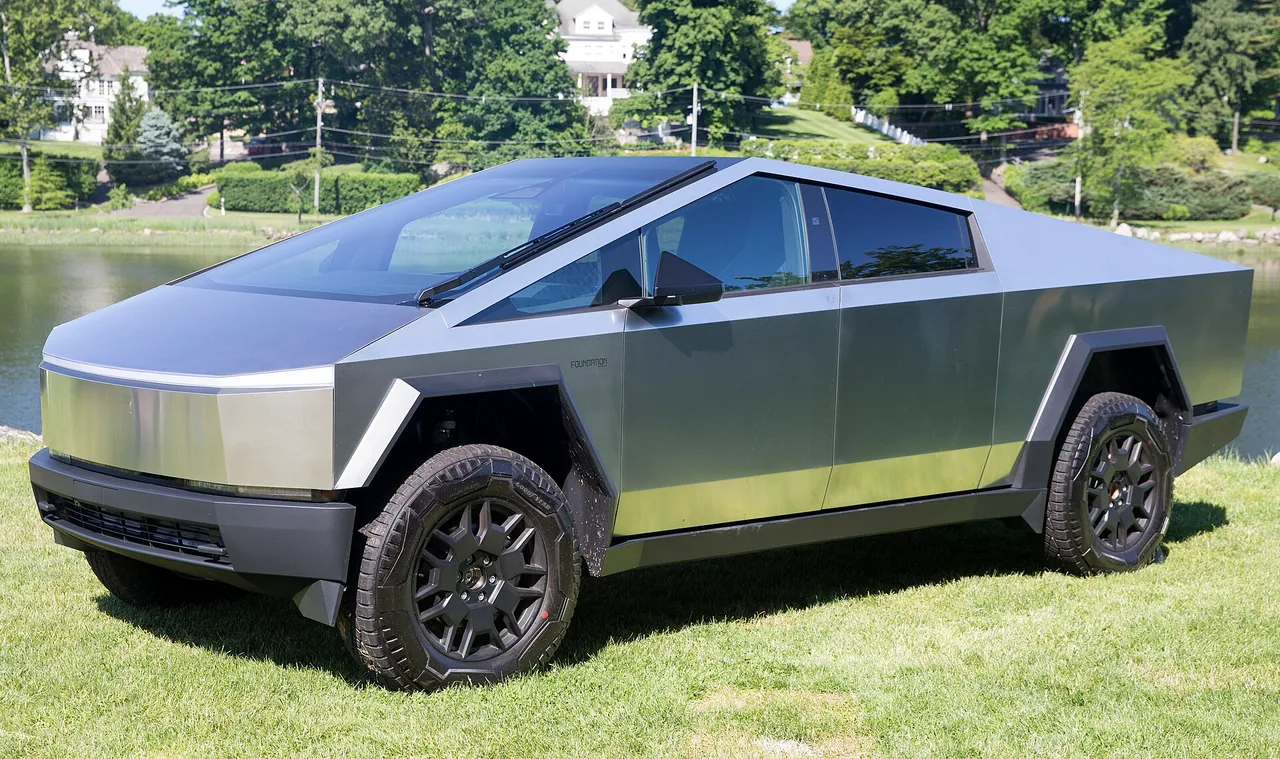

Compare the 2025 Tesla Cybertruck trims
| Trim | TrimIndex score | Price new | Used price | Drive | EPA range | EPA energy use | 0–60 mph | DC fast-charge peak | Towing |
|---|---|---|---|---|---|---|---|---|---|
| Long Range | 75 | from $69,990starting price | not stated | RWD | 335 mi | 40.9 kWh/100 mi | 6.2 s | 325 kW | 7,500 lb |
| Long Range (20in Cyber wheels) | 73 | not stated | not stated | RWD | 335 mi | 43.4 kWh/100 mi | 6.2 s | 325 kW | 7,500 lb |
| AWD | 73 | from $79,990starting price | $77,998–$92,986Dealer asking (45 listings, Nov 2026) | AWD | 325 mi | 42.9 kWh/100 mi | 4.1 s | 250 kW | 11,000 lb |
Price new, 0–60 mph, dc fast-charge peak and towing: Tesla, Inc., via the Internet Archive.
EPA range and EPA energy use: U.S. EPA and DOE, fueleconomy.gov.
Used price: the figure each trim page shows, with its source and the month collected.
TrimIndex score: out of 100.
Blank cells. Price new (1 row): no manufacturer price for that trim on file; Used price (2 rows): no used price for that trim on file.
What differs between the 2025 Tesla Cybertruck trims
Compared with the 2025 Cybertruck Long Range, the AWD has all-wheel drive, a 0–60 mph claim 2.1 s quicker and 3,500 lb more towing capacity, with 10 fewer miles of EPA range, a DC fast-charge peak 75 kW lower, EPA energy use 2.0 kWh/100 mi higher and a starting price $10,000 higher.
Which 2025 Tesla Cybertruck trim for what
- Longest EPA range: the 2025 Cybertruck Long Range, 335 miles; next, the AWD has 325 miles.
- Quickest 0–60 mph (manufacturer claims): the 2025 Cybertruck AWD, 4.1 seconds; next, the Long Range has 6.2 seconds.
- Highest towing rating (manufacturer): the 2025 Cybertruck AWD, 11,000 lb; next, the Long Range has 7,500 lb.
- Lowest EPA energy use: the 2025 Cybertruck Long Range, 40.9 kWh/100 mi; next, the AWD has 42.9 kWh/100 mi.
NHTSA Recalls (3)
- NHTSA lists 3 recall campaigns for the 2025 Tesla Cybertruck, filed between Mar 2025 and Apr 2026.
- How they are fixed, per the filings: 1 by a software update (it can install over the air) and 2 by work on the car.
Source: NHTSA recall filings for the 2025 Tesla Cybertruck, data through Nov 22, 2026. Why the VIN decides
- Filed Apr 2026
The brake rotor stud holes may crack and allow the stud to separate from the wheel hub.
Campaign #26V255000 · Part (NHTSA): service brakes, hydraulic › foundation components › disc › rotor- What happens:
- Wheel stud separation can cause a loss of vehicle control, increasing the risk of a crash.
- The fix
- Free fix: work on the car by Tesla Service Tesla Service will replace the front and rear brake rotors, hubs, and lug nuts, free of charge.
- Covers:
- certain 2024-2026 Cybertruck vehicles equipped with 18-inch steel wheels.
NHTSA lists 173 vehicles in this campaign (all models it covers).
Check VIN status at NHTSA.gov - Filed Oct 2025
The vehicle controller software may cause the front parking lights to be too bright and exceed the maximum light output, adversely affecting the vision of other drivers.
Campaign #25V699000 · Part (NHTSA): exterior lighting- What happens:
- Parking lights that are too bright can reduce visibility of oncoming drivers, increasing the risk of a crash.
- The fix
- Free fix: software update over the air Tesla released an over-the-air (OTA) software update, free of charge.
- Covers:
- certain 2024-2026 Cybertruck vehicles operating software prior to 2025.38.3.
- Federal standard not met:
- 108 (Lamps, Reflective Devices, and Associated Equipment).
NHTSA lists 63,619 vehicles in this campaign (all models it covers).
Check VIN status at NHTSA.gov - Filed Mar 2025
The light bar can delaminate and detach from the vehicle.
Campaign #25V170000 · Part (NHTSA): structure › body- What happens:
- A detached light bar can become a road hazard, increasing the risk of a crash.
- The fix
- Free fix: work on the car by Tesla Service Tesla service will replace the cant rail assembly, free of charge.
- Covers:
- certain 2024-2025 Cybertruck vehicles.
NHTSA lists 46,096 vehicles in this campaign (all models it covers).
Check VIN status at NHTSA.gov
NHTSA Investigations (2 open)
NHTSA has 2 open investigations covering the 2025 Tesla Cybertruck (NHTSA investigations file of Nov 19, 2026).
What these kinds of action mean
- OpenEngineering analysis EA26002, opened Mar 18, 2026
FSD Collisions in Reduced Roadway Visibility Conditions
What NHTSA says it is examining: The Office of Defects Investigation (ODI) is opening this Engineering Analysis to evaluate Tesla’s Full Self Driving Beta and Full Self Driving (Supervised) (collectively, FSD) degradation detection system.
Model years NHTSA lists for this model in the action: 2023-2026.
- OpenPreliminary evaluation PE25012, opened Oct 7, 2025
Traffic safety violations while Full Self Driving ("FSD") is engaged
What NHTSA says it is examining: The Office of Defects Investigation (“ODI”) is opening this Preliminary Evaluation (PE) to assess the scope, frequency, and potential safety consequences of FSD executing driving maneuvers that constitute traffic safety violations.
Model years NHTSA lists for this model in the action: 2023-2026.
Source: NHTSA Office of Defects Investigation, investigations file, records through Nov 19, 2026; an open investigation is not a finding of a defect in the 2025 Tesla Cybertruck.
NHTSA Complaints (28 total)
NHTSA lists 3 recall campaigns for the 2025 Tesla Cybertruck; 1 of them names an over-the-air software update as the fix. Owners have filed 28 complaints with NHTSA; the largest part groups are Electrical system (other) (6) and Forward collision avoidance (6). Of all 28, 2 report a crash and 2 an injury.
What owners report most
TrimIndex grouped the 28 complaints owners filed with NHTSA on the 2025 Tesla Cybertruck (every trim; NHTSA files complaints by model year, not trim) into problem themes on Nov 16, 2026: 6 of them fall in the theme below. 2 complaints were filed after that grouping and are not in a theme yet. How themes are made and checked
-
Self-driving steers or moves unexpectedly
6 of 28 complaints (21%): Owners report Autopilot or Full Self-Driving drifting within or out of the lane, turning abruptly, or moving forward unexpectedly, in some cases striking other vehicles or objects.
Owners reported a crash in 1 of the 6 complaints.
“the car decided to make an abrupt illegal right turn from a straight only lane”
NHTSA complaint 11669985 “The vehicle will consistently pull toward the left side of the lane, positioning itself directly on the left lane line.”
NHTSA complaint 11699487
28 complaints filed with NHTSA for the 2025 Tesla Cybertruck, between Jun 2025 and Nov 2026.
Parts named most often
| Part | Complaints | Share |
|---|---|---|
| Electrical system (other) | 6 | 21% |
| Forward collision avoidance including adaptive cruise control (4) | 6 | 21% |
| Lane keeping and blind-spot systems including assist (5) | 6 | 21% |
| Steering | 4 | 14% |
| Body and structure including body (4) | 4 | 14% |
Share of all 28 complaints; one complaint can name more than one part, so shares add up to more than 100%. 1 complaint names no specific part.
Owners reported a crash in 2 and an injury in 2 of the 28 complaints. How these fields are filled
Complaints by year filed
| Year filed | Complaints |
|---|---|
| 2025 | 10 |
| 2026 (to Nov 22) | 18 |
Source: NHTSA owner complaints filed on every 2025 Tesla Cybertruck (NHTSA files them by model year, not trim), data through Nov 22, 2026.
The 25 most severe, then newest, of 28
- Severity 5 of 5.Lane keeping and blind-spot systems · Steering · Brakes Injury · Crash
HTSA Safety Complaint Description The 2025 Tesla Cybertruck exhibits a persistent and recurring air suspension system defect that impairs safe vehicle operation.
Show the rest
From the moment of delivery, the air suspension failed to raise or lower properly, displaying a fault message indicating potential restoration on the next drive. This did not occur. The issue included repeated overheating warnings, multiple system failure alerts, excessive compressor noise/knocking, steam and water discharge from the undercarriage, and the vehicle remaining stuck in a lowered ride height, causing scraping damage to underbody trim and mud flaps. The vehicle underwent a major warranty repair where the air suspension compressor was replaced due to a stuck exhaust valve and damaged air line, followed by recalibration. Despite this, suspension overheating warnings and intermittent system failure notifications continued to appear. On December 23, 2025, while driving at moderate speed in clear conditions, the vehicle suddenly and uncorrectably migrated off the roadway. Adaptive steering correction, braking intervention, and lane assist failed to engage. At the time of the incident, the display actively showed service notifications indicating suspension system failure and overheating. The vehicle veered into a ditch, resulting in a significant drop and requiring specialized heavy-duty extraction. This defect has impaired the vehicle’s handling, stability, and safety from delivery onward, with no resolution after attempted repair. The recurring nature and active failure alerts during the loss-of-control event suggest a serious safety risk.
NHTSA ODI #11709502 - Severity 5 of 5.Electrical system (other) Injury at 7,857 miles
The contact owns a 2025 Tesla Cybertruck. The contact stated that while the vehicle was parked, the contact exited the vehicle and the front driver-side door independently closed
Show the rest
and slammed his right hand in the door, injuring three of his fingers. The contact sought medical attention and was informed that he had sustained internal bleeding and was prescribed anti-inflammatory medicine and instructed the contact to try not to move his fingers in order to avoid disturbing the healing process. The contact stated he also sustained emotional distress and described the incident as traumatic. The vehicle was taken back to the residence and was not diagnosed. A dealer was not contacted, and the vehicle was not repaired. The manufacturer was notified of the failure, and the contact stated that the manufacturer said they would send an email after the call; however, the manufacturer did not send an email and refused to provide a manufacturer case number. The failure mileage was approximately 7,857.
NHTSA ODI #11704541 - Severity 4 of 5.Brakes · Suspension
I am submitting this complaint regarding two serious safety-related failures with my Tesla Cybertruck: a braking-system malfunction and a rear suspension/subframe failure at
Show the rest
approximately 12,500 miles. The vehicle previously experienced a significant braking problem that required repair by an authorized Tesla Service Center. The initial repair did not properly resolve the issue, requiring the vehicle to return for additional service. Because the problem involved the braking system, I was concerned about the vehicle's ability to stop safely and predictably, creating a risk of a serious collision. Tesla's service records should document the diagnosis, repairs, and any related fault codes. At approximately 12,500 miles, the vehicle experienced a major failure involving the rear suspension/subframe. The rear suspension separated/dropped in relation to the subframe, causing significant damage. Tesla inspected the vehicle and performed extensive repairs involving the rear subframe, including component/part number 1250562-00-E. This failure created a serious safety risk because the rear suspension/subframe affects vehicle stability, wheel positioning, handling, and control. If this failure had occurred while traveling at highway speed, it could have caused loss of control, a serious collision, injury, or death. Due to the condition of the vehicle, I had it towed rather than driving it. To my knowledge, there was no meaningful advance warning that a major suspension/subframe failure was about to occur. Tesla should have diagnostic logs, photographs, technician findings, repair records, and information concerning the failed components. I also have photographs and service documentation. Having experienced both a braking-system problem and a major suspension/subframe failure at low mileage has caused serious concerns regarding the safety of this vehicle. I am requesting that NHTSA investigate whether similar failures have occurred in other Cybertrucks.
NHTSA ODI #11758503 - Severity 4 of 5.Seat belts · Seats · Air bags
My 2025 Tesla Cybertruck AWD (VIN: [XXX] ) has a recurring failure of the right rear seat occupant detection system, which governs airbag deployment and is certified by Tesla to meet FMVSS 208.
Show the rest
The same alert (internal code RCM2_a698) persisted through two official repairs at Tesla Palo Alto: 1st repair (Invoice XXX, 8/22/2025): seat belt buckle replaced. Alert recurred 2 days later, August 24, 2025. 2nd repair (Invoice XXX, 9/18/2025): harness assembly replaced. Tesla then performed a Visual Quality Check, recording in the invoice: "Technician performed a visual quality check to make sure its condition meets our standards." Vehicle returned as repaired. Relying on Tesla's written certification, I reinstalled my [XXX] son's car seat in that position. He rode there daily for approximately 7 months (September 2025 - April 2026). On April 21, 2026, I tested the seat and found the sensor still actively failing - unable to detect an adult occupant. My spouse witnessed this. I have 30-second video. Alert RCM2_a698 remains active in Tesla's systems today, confirmed by screenshot. This is my family's only vehicle. My wife currently uses the right rear seat. Airbag deployment for that seat cannot be relied upon. Tesla has been notified and has not resolved this issue. INFORMATION REDACTED PURSUANT TO THE FREEDOM OF INFORMATION ACT (FOIA), 5 U.S.C. 552(B)(6)
NHTSA ODI #11737205 - Severity 4 of 5.Forward collision avoidance Crash
While FSD was actived, my cyber truck was driveing on lane 2, it steered to the right on while passing a truck to its right side unsafely. The truck on lane 3 hit my right back wheel, and then it hit another truck on lane 4.
NHTSA ODI #11735608 - Severity 4 of 5.Electrical system (other) · Drive unit · Steering
The Power Conversion System (PCS) in the Tesla Cybertruck is experiencing a high rate of hardware-level failure (specifically the PCS2 module) that poses three distinct safety
Show the rest
risks beyond the loss of AC charging. Loss of Steer-by-Wire Integrity: The Cybertruck utilizes a full steer-by-wire system and a 48V low-voltage architecture. The PCS is responsible for managing the 48V bus and charging the LV battery. A hardware failure in the PCS (common alerts: PCS2_a094, PCS2_a137) threatens the stability of the 48V system. Any sudden collapse of the 48V bus while in motion could result in a total loss of steering control and vehicle maneuverability, creating an immediate risk of a high-speed collision. Loss of Propulsion and Stranding: PCS failure frequently leads to "limp mode" or a "no-start" condition where the vehicle cannot engage Drive or Reverse. Experiencing a loss of propulsion while in active traffic or being stranded on a highway shoulder without the ability to move the vehicle creates a severe life-safety hazard for occupants and other motorists. Failure of Visibility Systems: Critical safety components, including the primary windshield wiper and exterior lighting, are powered via the 48V system managed by the PCS. Hardware instability has led to reports of these systems failing during inclement weather, severely compromising driver visibility. Tesla has implemented software bypasses (OTA updates) to allow DC Supercharging when the AC hardware fails, but this is a "band-aid" that does not address the underlying hardware defect—likely MOSFET degradation. With replacement parts on backorder for 8+ weeks, owners are forced to operate vehicles with compromised electrical architectures. I am reporting this as a systemic hardware defect that requires an official safety recall.
NHTSA ODI #11734532 - Severity 4 of 5.
Tesla sold me a 2025 Cybertruck RWD without disclosing that no compatible bed cover exists at all for this model. We test-drove the vehicle at Tesla Clermont and took delivery at Tesla Tallahassee.
Show the rest
At neither location were we told that the RWD trim cannot use the powered hard tonneau cover OR the soft tonneau cover. After delivery, Tesla confirmed in writing that the only cover associated with this model is out of stock with no ETA, and they “cannot speculate on availability.” No third-party manufacturer offers a compatible cover. This means the vehicle’s truck bed cannot be covered or secured in any manner. As a result, we experienced two serious safety incidents. Both times, the vehicle was operating in SFD (self-drive) mode at speeds below the posted speed limit, with items properly tied down using rope. Even under safe, controlled conditions, items flew out of the truck bed twice, nearly causing a collision behind us. Vehicles had to brake and swerve to avoid debris. These incidents created a direct hazard to us and the surrounding traffic. The Cybertruck RWD cannot safely retain cargo under normal driving conditions without a cover, and no cover exists or can be purchased. Tesla buried a clause in a 45-page contract saying they may “remove parts from commerce,” but this does NOT excuse failing to disclose that no safe cargo-retention solution exists for the RWD configuration. A pickup truck that cannot keep cargo from ejecting onto the roadway presents a serious safety defect. I am reporting this because the inability to secure a load is a safety hazard for both occupants and other drivers, and Tesla has no remedy available. Thank you
NHTSA ODI #11699606 - Severity 4 of 5.Seat belts
I’ve had a model 3,model y and now a cybertruck, can’t speak on the rest of the fleet but didn’t had this problem with those cars or any my other cars in the pass, but the
Show the rest
passenger side seat belt keeps locking up, if you have to reach down to get an item or reach back it locks up, even if you go a few inches over it locks up which which needs constant taking the seat belt off and resetting it which become a safety issues while driving for the passenger, I took it to the dealership and they said it’s normal, I feel like the seat belt is short which makes it lock up as it should or other defect, I tasted on another cybertruck and didn’t had that problem, tesla customer service didn’t wanted to help me and push me away, I google the problem and there a forum and people having the same problem
NHTSA ODI #11698678 - Severity 3 of 5.Lane keeping and blind-spot systems · Steering
After I cancelled the $99/month Full Self-Driving (Supervised) subscription in November 2026, the Autosteer lane-centering feature disappeared entirely from the vehicle.
Show the rest
Only Traffic-Aware Cruise Control (speed control) remains. I checked the car's settings and there is no Autosteer on/off switch anywhere — the feature did not just turn off, it is gone from the vehicle. I had bought the Cybertruck in September 2025 with standard Autopilot including Autosteer, before Tesla's January 2026 change removing Autosteer from new orders, and received no notice from Tesla (app, email, or in-car) that cancelling FSD would remove Autosteer. On November 17, 2026, while driving the Cybertruck, I expected Autosteer to keep the vehicle in its lane as it had before; it did not steer, and I had to correct course suddenly to avoid an accident. I consider this a safety defect: a driver-assistance steering feature silently removed after a subscription cancellation, with no warning.
NHTSA ODI #11778865 - Severity 3 of 5.Forward collision avoidance · Lane keeping and blind-spot systems
Interior factory component off-gassing causes a recurring residue film on the internal glass of the forward-facing camera, completely blinding the vehicle's primary safety systems and FSD.
Show the rest
Tesla Service refuses to rectify the defect under warranty, calling it standard maintenance, forcing owners to drive with compromised driver-assist features or pay recurring out-of-pocket fees.
NHTSA ODI #11750193
Show 15 more complaints
- Severity 3 of 5.Driver-assist system · Speed control at 13,000 miles
The contact owns a 2025 Tesla Cybertruck. The contact stated that while pulling into a charging station with the self-driving system activated, the vehicle stopped in front of the
Show the rest
payment pole; however, the vehicle inadvertently accelerated through the barrier gate arm, and the arm was fractured. The barrier scratched the passenger’s side bumper. A police report was not filed. There were no injuries sustained. The vehicle was not diagnosed or repaired. The manufacturer was notified of the failure. The failure mileage was approximately 13,000.
NHTSA ODI #11745888 - Severity 3 of 5.Electrical system (other)
PCS2 failure. The PCS2 board manages charging and power conversion. Failures typically start by restricting home AC charging speeds (e.g., dropping from 48A down to 24A) and can
Show the rest
eventually result in a complete loss of AC charging and a "Charging Unavailable" alert.
NHTSA ODI #11745238 - Severity 3 of 5.Electrical system (other)
My 2025 Tesla Cybertruck AWD (VIN: [XXX] ) was returned to me after the first service visit (Invoice XXX Tesla Palo Alto, 8/22/2025) with the Pedestrian Warning System (PWS) speaker disconnected.
Show the rest
The disconnection occurred during front-end service work at that visit, which included front fascia inspection and removal. The technician did not reconnect the PWS speaker before returning the vehicle. The disconnection was not discovered until the second service visit (Invoice XXX, Tesla Palo Alto, 9/18/2025), at which point Tesla's own invoice documented: "The issue was caused by a disconnected front pedestrian warning speaker. Technician reconnected the front pedestrian warning speaker to resolve the issue." The [XXX] s therefore operated with a disconnected PWS for approximately 4 weeks — from August 22 to September 18, 2025 — without my knowledge. During this entire period, the vehicle was not emitting the required audible low-speed alert. The PWS emits an audible alert at low speeds to warn pedestrians, cyclists, and visually impaired individuals of the vehicle's approach. This system is required under FMVSS 141 (Minimum Sound Requirements for Hybrid and Electric Vehicles). This is a service-inflicted deactivation of a federally-required pedestrian safety system. The deactivation was caused by Tesla's Palo Alto service center (4180 El Camino Real, Palo Alto, CA 94306) during routine warranty repair work. The vehicle was returned to me without disclosure of the disconnection. INFORMATION REDACTED PURSUANT TO THE FREEDOM OF INFORMATION ACT (FOIA), 5 U.S.C. 552(B)(6)
NHTSA ODI #11737207 - Severity 3 of 5.Electrical system (other)
Brand-new 2025 Cybertruck developed moisture inside sealed HV battery pack with no submersion, off-roading, or flooding.
Show the rest
Service photos show only trace condensation and crystallized residue—no mud, corrosion, or contaminants. Tesla denying warranty and quoting $37k replacement. Suspected manufacturing defect in pack lid gasket (known issue in early VINs). Safety risk if unaddressed.
NHTSA ODI #11704449 - Severity 3 of 5.Lane keeping and blind-spot systems · Forward collision avoidance
Since purchasing my Cybertruck with Full Self-Driving in July 2025, I have experienced a repeated safety issue whenever Autopilot/FSD is engaged on highways.
Show the rest
The vehicle will consistently pull toward the left side of the lane, positioning itself directly on the left lane line. This feels extremely unsafe, especially when another vehicle is traveling in the lane beside me. This behavior happens at highway speeds and creates a significant safety concern because it reduces the buffer between my vehicle and adjacent traffic. The issue has occurred repeatedly over several months in different locations and conditions. I have brought the vehicle to Tesla service multiple times, and the issue has not been resolved. Tesla acknowledged the concern happened to multiple vehicles in the past two months, but was unable to fix it. They are now performing another inspection for my vehicle, and starting a buyback request that is under review. There are no warning messages before or during the behavior. This appears to be a malfunction with the vehicle’s lane-keeping or Autopilot/FSD behavior that puts my safety and the safety of others at risk.
NHTSA ODI #11699487 - Severity 3 of 5.Lane keeping and blind-spot systems
When on full self driving on the freeway if the road starts curving the car does not stay in the lane and start hitting the bump on the road or in situation getting to close to another car or the center diver
NHTSA ODI #11698679 - Severity 3 of 5.Forward collision avoidance · Steering
Driving the cybertruck on a road going straight no set destination on the cars navigation with autopilot on so it should have continued straight for the most part….
Show the rest
but the car decided to make an abrupt illegal right turn from a straight only lane after passing the appropriate right merge lane. After which the car swerved illegally into 2 oncoming traffic lanes before briefly missing an oncoming car then me driver manually pulled back into the correct lane. By the way my 12 pound dog which sits in the passenger seat was swung so hard hard by the abrupt turn that she literally ended up in the driver foot well by my ankles. This has never ever happened from my regular driving! I’m not so upset about my dog so much as I am trying to convey the amount of abrupt rough turn the car did. Very last minute and doing anything but let the car do the turn may have resulted in me crashing into oncoming traffic had there been any. A terrible illegal scary occurrence by Tesla autopilot. I was left very stunned. Please contact me for additional information I did record the dashcam footage and would like to share that.
NHTSA ODI #11669985 - Severity 2 of 5.Body and structure
On [XXX], while my partner and I were driving toward Duxbury Beach, Massachusetts, at about 5 mph, our golden retriever pressed the interior rear door open button and the rear door
Show the rest
unlatched and opened while the vehicle was moving. We were able to react and grab her only because we were going so slowly. At highway speed she would have been pulled out. The rear interior door release on the Cybertruck can be activated while the vehicle is in motion, with no speed-based lockout. A dog or a young child can open it with a single press. This button has been live on every trip we have taken with her, including hundreds of highway drives. Nothing in the vehicle would have stopped her opening that door at 65 mph. I have since turned on the rear child locks and the rear window lock. I also noticed the rear window lowered by itself before I enabled the lock. These are opt-in settings most owners will not know they need until something like this happens. I am asking that the rear interior door release be automatically disabled above a low speed (about 3 mph) unless the vehicle is in Park, and that rear child locks be enabled by default or prompted when a rear passenger or Dog Mode is detected. Photos attached show the dog in the rear seat next to the door. INFORMATION REDACTED PURSUANT TO THE FREEDOM OF INFORMATION ACT (FOIA), 5 U.S.C. 552(B)(6)
NHTSA ODI #11779538 - Severity 2 of 5.Suspension · Forward collision avoidance · Electrical system (other)
They swamped many parts from 1k tires swamped with bald tires, wheel covers switched, manager popped my window switches, blown suspension, main camera module swamped, das gone,
NHTSA ODI #11773126 - Severity 2 of 5.Windshield wipers
Subject: Vehicle Safety Complaint – Tesla Cybertruck Unexpected Movement While Full Self-Driving Was Engaged** I am submitting this complaint regarding an accident involving my
Show the rest
Tesla Cybertruck and the vehicle’s Full Self-Driving (FSD) system. On XXX at approximately 6:10 p.m. in [XXX], I was traveling westbound on [XXX]. I came to a complete stop at a red traffic signal at the intersection of [XXX] and [XXX]. Full Self-Driving was engaged and operating the vehicle at the time. After the Cybertruck had remained completely stopped at the red light for approximately 10–15 seconds, it suddenly began moving forward without any intentional acceleration or other input from me. The vehicle struck the vehicle stopped directly in front of it and then came to a stop. I am reporting this incident because the vehicle moved unexpectedly while FSD was engaged and the vehicle was already stopped at a red light. This behavior created a collision and may present a safety risk to occupants, pedestrians, and other road users. I have photographs of the vehicles and the accident scene. I am also preserving the relevant vehicle camera footage and other evidence associated with the incident. Tesla has been asked to document the event, review the vehicle’s logs, FSD data, and camera footage, and preserve all relevant information. I request that NHTSA investigate this incident and determine whether it may indicate a defect or safety issue involving Tesla’s FSD system, vehicle controls, or related software. I also intend to have the vehicle inspected by Tesla to identify any damage or safety-related issues resulting from the collision. Thank you INFORMATION REDACTED PURSUANT TO THE FREEDOM OF INFORMATION ACT (FOIA), 5 U.S.C. 552(B)(6)
NHTSA ODI #11771640 - Severity 2 of 5.Seats
I own a 2025 Tesla Cybertruck AWD. The fixed lower rail beneath the front passenger seat has two exposed openings.
Show the rest
On September 7, 2026, a metal key fell through one opening into an inaccessible enclosed area beneath the seat and floor structure. The key could not be seen or retrieved. While driving, I repeatedly heard it sliding as the vehicle accelerated, stopped and turned. I attempted to reach it by creating a hand-sized opening in the lower protective panel, damaging that panel, but I still could not locate the key. While parking in my garage, I suddenly heard the key drop into a deeper area instead of continuing to slide. The unexpected sound startled me and I immediately braked. During this abrupt reaction in the confined garage, the right exterior mirror struck the garage structure and was damaged. This presents a design and safety concern. Small everyday objects can fall through the exposed seat-rail openings into an inaccessible vehicle cavity, move unpredictably and distract the driver. There is no apparent cover, screen or plug, and no reasonable owner-accessible retrieval method. I request that Tesla explain the purpose of these openings and why they are unprotected; inspect the vehicle and confirm whether the key could affect wiring, seat components, the battery enclosure or other systems; remove the passenger seat and necessary trim to retrieve the key; repair the damaged lower panel; and repair or provide reimbursement or goodwill assistance for the damaged right mirror. Tesla should also protect the vehicle’s existing paint protection film during repair and escalate the openings to its engineering or product-safety team for a preventive solution. I can provide photographs of both openings, the damaged panel and mirror, and can provide my VIN privately.
NHTSA ODI #11762622 - Severity 2 of 5.Wheels
My 2025 Tesla AWD Cybertruck's rear driver 20" wheel came loose, creating a loud banging noise. The wheel nuts on 2 of the studs worked finger-loose, and one of the studs broke off the hub.
Show the rest
The truck had 9000 miles on the odometer. Tesla's service dept blamed me for improperly rotating the tires, but I had never removed or replaced them.
NHTSA ODI #11750853 - Severity 2 of 5.Body and structure
The vehicle's rear structural Giga Casting sustained severe structural failure, exhibiting two distinct cracks following an impact.
Show the rest
The vehicle and the damaged casting are fully available for inspection upon request at my current location/service center. The safety risk is extreme. The Giga Casting is a core load-bearing structural component of the vehicle. Cracking in this area severely compromises the vehicle's structural integrity. If the vehicle continues to be driven, any subsequent minor impact or even routine road vibrations could lead to a catastrophic structural collapse, complete loss of vehicle control, or unpredictable battery pack intrusion, putting my life and other road users at severe risk. the structural cracks on the Giga Casting have been inspected and confirmed by the Tesla Service Center and I been told by the technician the casting is very easy to get damaged. When the accident happened the most cybertruck get damaged in the casting
NHTSA ODI #11746900 - Severity 2 of 5.Body and structure
Front body panel of hood came unglued
NHTSA ODI #11719516 - Severity 2 of 5.Suspension · Forward collision avoidance · Lane keeping and blind-spot systems
One to two times per month upon starting my Cybertruck I receive multiple notifications for systems not working including "Driver Assistance - Automatic Emergency Braking is
Show the rest
unavailable" and "Steering & Braking - Adaptive ride control degraded/Ride comfort may be reduced." These alerts cause the disablement of the regenerative braking, auto-hold (braking), emergency braking, adaptive ride control, traction control, and the self drive features. While the vehicle is still drivable, my ability to control the vehicle is greatly diminished, as is the safety of the vehicle without any of the accident avoidance and stability systems working. After driving in this condition, if I park the vehicle, exit it, and let it sit for at least 10 minutes, all systems are normal upon reentry. On 1/5 I experienced this issue and opened a service request for warranty work and Tesla demanded that I agree to a $200 charge before they would even look at it and said if they were unable to see the issue then it would not be considered as warranty. Since I cannot reproduce this issue on demand I cancelled the service request as I do not want to pay them $200 to say they couldn't reproduce the issue. Internet searches have revealed that this is a common issue among Cybertrucks and despite multiple software updates since owning my vehicle, it has not gotten any better.
NHTSA ODI #11709187
NHTSA 5-Star Crash-Test Ratings
Each 2025 Tesla Cybertruck trim matches more than one variant NHTSA tested, so no crash-test rating is shown.
2025 Tesla Cybertruck frequently asked questions
What trims does the 2025 Tesla Cybertruck come in?
TrimIndex lists 2 configurations of the 2025 Tesla Cybertruck, as EPA names them: Long Range and AWD. 1 wheel, tire or charger option is listed under its trim.
What is the difference between the 2025 Tesla Cybertruck Long Range and AWD?
Compared with the 2025 Cybertruck Long Range, the AWD has all-wheel drive, a 0–60 mph claim 2.1 s quicker and 3,500 lb more towing capacity, with 10 fewer miles of EPA range, a DC fast-charge peak 75 kW lower, EPA energy use 2.0 kWh/100 mi higher and a starting price $10,000 higher.
What is the range of the 2025 Tesla Cybertruck?
EPA rates the 2025 Tesla Cybertruck at 325 to 335 miles, depending on the configuration: 335 for the Long Range and 325 for the AWD.
Are there recalls on the 2025 Tesla Cybertruck?
Yes. NHTSA lists 3 recall campaigns for the 2025 Tesla Cybertruck in records through Nov 22, 2026: 25V170000 (body), 25V699000 (exterior lights) and 26V255000 (brakes).
What problems do owners report on the 2025 Tesla Cybertruck?
Of the 28 complaints owners filed with NHTSA about the 2025 Tesla Cybertruck in records through Nov 22, 2026, the largest problem theme is: Self-driving steers or moves unexpectedly (6). 6 of them fall in the one theme TrimIndex grouped from their narratives on Nov 16, 2026.