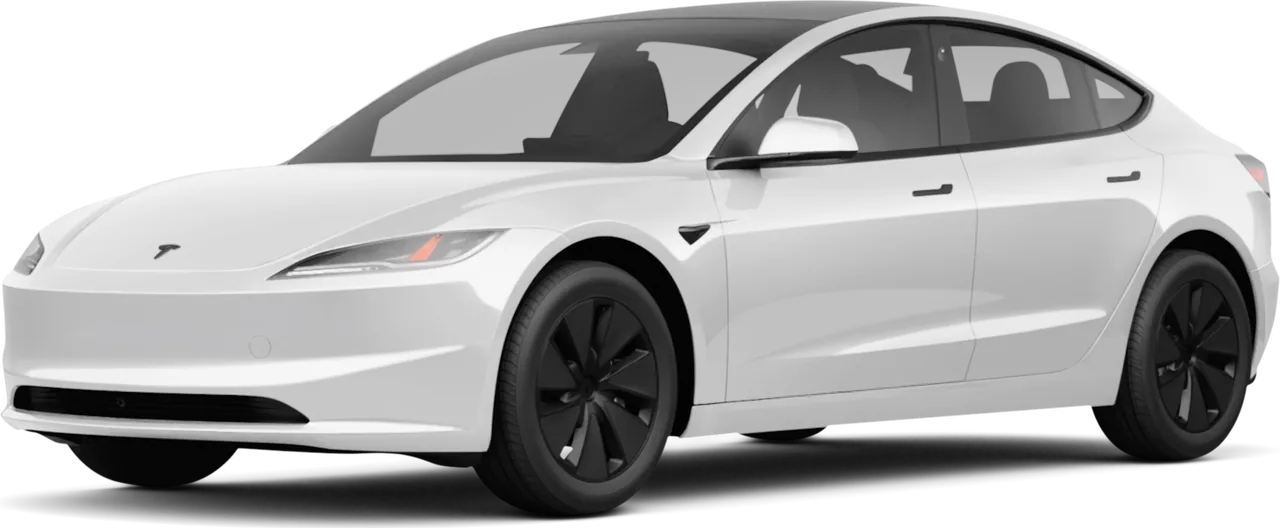
2026 Tesla Model 3 Performance
Electric Sedan · AWD
Based on battery health, build quality, owner data, EPA range, and market pricing
Above average for 2026 EV Sedans (class avg 69 · top 14%)
Personalize this scoreIs a low score bad?
Last scanned 25 days ago
The 2026 Tesla Model 3 Performance is rated at 309 miles of EPA range and 250 kW fast charging, and the score gets it into the conversation; battery and service records decide whether to make an offer.
Score read
A 75/100 makes this good enough to inspect, not good enough to skip diligence. Software and driver-assist score is 88/100, but owner feedback score is only 51/100. Owners on Reddit repeatedly cite owner satisfaction and battery degradation as recurring problems. Treat missing repair records as a price problem, not a footnote.
Price context
Used examples are running around $56,380. Treat that as a budgeting floor, not a final price; pull a current KBB Fair Purchase or Edmunds True Market Value for this exact trim before negotiating.
Who this is for
✓ Good for
- ⏱ Daily commuter ≤50 mi/day, predictable charging
- ↦ Road tripper Long trips, needs DC fast network
- ★ Weekend driver Performance, fun, low mileage
✗ Avoid if you are a
- $ Bargain hunter Best TCO, reliability + low depreciation
Gotchas
- Serviceable Recall paperwork has to match the exact VIN.
Mitigation Use NHTSA and the automaker lookup, then require repair records instead of a verbal promise.
- Verify Owner feedback is the part to read carefully (51/100).
Mitigation Read the complaint themes and ask whether this VIN has already had those issues repaired.
Pre-purchase inspection
- 1 Run the exact VIN through NHTSA and the automaker recall lookup before discussing price.
- 2 Compare the dashboard range estimate with the EPA 309-mile rating after a full charge.
- 3 Confirm how much of the 8-year/120,000-mile battery warranty remains and whether it transfers.
- 4 If road trips matter, run a short DC fast-charge session and watch whether speed tapers normally.
- 5 Read the complaint themes, not just the count, and ask the seller whether those issues have shown up on this VIN.
VIN status first This model has 1 NHTSA recall record. The exact VIN lookup decides whether the car in front of you is clear.
Complaint context This scan found 4 NHTSA complaint records (0 per 10K VINs, low for any vehicle class). Read the themes below before treating the raw count as the verdict.
Price needs outside confirmation Current market pricing is incomplete, so MSRP should not be used as the deal signal. Compare KBB, J.D. Power, and live listings for this exact trim.
Pricing & Market Value
Score Breakdown
What matters most to you?
Drag the sliders to prioritize what you care about. Your TrimIndex Score recalculates instantly.
Vehicle Specifications
The federal $4,000 used-EV credit ended Sept 30, 2025.
But 10 states still run their own used-EV rebate programs — some up to $5,000. Pick your state to see what's available for this trim.
Source & disclaimer
Dealers make ~$3,575 on the average car loan.
After the price is set, the finance manager runs four plays to rebuild margin. Every buyer without a pre-approval is a target. Here's exactly what they run — and what stops each one.
78% of dealer loans carry a hidden +1.13% markup above what the lender actually charges. You never see it — it's buried in the contract. · CFPB
Dealer must match or beat your lender — they can't add margin invisibly. The markup play is dead on arrival.
Once you answer, they stretch the term to hit your number. Median result: $4K less off the price, 12 more months on the loan. · Industry avg
Financing is done. Only the sale price is on the table — and the dealer knows it.
Back-office F&I profit averages $1,975/vehicle, up 8.5% YoY. These products exist — but dealer markup is 4–10x what you'd pay elsewhere. · Dealership Guy
Dealer GAP runs $500–1K. Your insurer sells the same coverage for $100–250 over 5 years. Now you know.
"Your loan fell through — come re-sign." This pulls your APR up +5% on average. It's legal. It works because you've already driven the car home. · Ctr for Responsible Lending
A lender commitment letter means the deal is final. "Pending dealer approval" doesn't apply. You can't be yo-yo'd.
Margin handed to the dealer's finance department — for nothing.
Takes 2 minutes. No obligation to use it — but you'll walk in with all the leverage.
Pre-approval is a soft credit inquiry — no score impact. FICO treats all auto-loan hard pulls within 14 days as one, so you can still shop rates at the dealer.
NHTSA Recalls (1)
Tesla, Inc. (Tesla) is recalling certain 2026 Model 3 and Model Y vehicles. The fasteners attaching the seat back to the seat bottom may have been improperly tightened.
The seat may not properly restrain the occupant, increasing the risk of injury during a crash.
Check VIN status at NHTSA.govNHTSA Complaints (4 total · 0 per 10K US vehicles · low for any vehicle class)
I was involved in a rear-end collision while stopped at an intersection. The impact was significant. During the crash, the front airbags did not deploy. More importantly, the seat belts in both front seats (driver and front passenger) failed to function as expected. Instead of tightening during impact, the seat belts appeared to loosen, allowing excessive forward movement of the occupants. As a result, I was thrown forward and struck the steering wheel. The lack of seat belt pretensioning raises serious concerns about a potential failure of the vehicle’s restraint system. This incident suggests that the seat belt pretensioners and/or related crash detection systems may not have activated properly under a significant collision event. I am concerned that this represents a safety defect that could increase the risk of injury in a crash. I request that this incident be investigated as a possible failure of the restraint system, including seat belt pretensioners and crash sensing mechanisms.
I was involved in a rear-end collision while stopped at an intersection. The impact was significant. During the crash, the front airbags did not deploy. More importantly, the seat belts in both front seats (driver and front passenger) failed to function as expected. Instead of tightening during impact, the seat belts appeared to loosen, allowing excessive forward movement of the occupants. As a result, I was thrown forward and struck the steering wheel. The lack of seat belt pretensioning raises serious concerns about a potential failure of the vehicle’s restraint system. This incident suggests that the seat belt pretensioners and/or related crash detection systems may not have activated properly under a significant collision event. I am concerned that this represents a safety defect that could increase the risk of injury in a crash. I request that this incident be investigated as a possible failure of the restraint system, including seat belt pretensioners and crash sensing mechanisms.
The vehicle's Full Self-Driving (FSD) system was actively controlling the vehicle while executing a reverse maneuver into a residential garage — a routine the system had successfully performed on multiple prior occasions. During this session, the FSD system misjudged the maneuver and the vehicle struck the wall of the garage, causing damage. The failed component is the FSD software/sensor system. The vehicle is available for inspection upon request. Safety was put at risk because the system was in full control of vehicle movement in a confined space. The unexpected behavior did not provide sufficient time for the supervising driver to intervene before impact. No warning lamps or messages appeared prior to the failure. The system gave no indication it would behave differently from previous successful executions of the same maneuver. The incident has not yet been confirmed by a dealer or inspected by the manufacturer, though a vehicle incident data report has been requested from Tesla.
The vehicle's Full Self-Driving (FSD) system was actively controlling the vehicle while executing a reverse maneuver into a residential garage — a routine the system had successfully performed on multiple prior occasions. During this session, the FSD system misjudged the maneuver and the vehicle struck the wall of the garage, causing damage. The failed component is the FSD software/sensor system. The vehicle is available for inspection upon request. Safety was put at risk because the system was in full control of vehicle movement in a confined space. The unexpected behavior did not provide sufficient time for the supervising driver to intervene before impact. No warning lamps or messages appeared prior to the failure. The system gave no indication it would behave differently from previous successful executions of the same maneuver. The incident has not yet been confirmed by a dealer or inspected by the manufacturer, though a vehicle incident data report has been requested from Tesla.
On February 5, 2026, at 12:21 PM PST, my 2026 Tesla Model 3 (Hardware 4) collided with a 5-inch wooden pillar while using the Autopark feature. The system failed to provide any audio chimes or visual warnings prior to the impact. I officially requested the driving logs from Tesla to investigate the cause of this failure, but Tesla refused to provide any logs or data. Furthermore, Tesla Service Center technicians insisted there were no hardware defects, effectively confirming that the collision was caused by a software/algorithmic failure of the Tesla Vision system to detect a stationary vertical object. Despite Tesla’s claim that the vehicle is "operating as designed," the system's inability to recognize common infrastructure and its failure to warn the driver constitutes a severe safety risk. This defect must be investigated to make sure the safety of the Hardware 4 autonomous platform, as the lack of proximity alerts could lead to far more serious accidents involving pedestrians or other obstacles.
On February 5, 2026, at 12:21 PM PST, my 2026 Tesla Model 3 (Hardware 4) collided with a 5-inch wooden pillar while using the Autopark feature. The system failed to provide any audio chimes or visual warnings prior to the impact. I officially requested the driving logs from Tesla to investigate the cause of this failure, but Tesla refused to provide any logs or data. Furthermore, Tesla Service Center technicians insisted there were no hardware defects, effectively confirming that the collision was caused by a software/algorithmic failure of the Tesla Vision system to detect a stationary vertical object. Despite Tesla’s claim that the vehicle is "operating as designed," the system's inability to recognize common infrastructure and its failure to warn the driver constitutes a severe safety risk. This defect must be investigated to make sure the safety of the Hardware 4 autonomous platform, as the lack of proximity alerts could lead to far more serious accidents involving pedestrians or other obstacles.
The vehicle's FSD system malfunctioned and initiated an unintended reverse toward a closing garage door. To prevent a total-loss event (the door crushing the glass roof and trunk), I was forced to perform an emergency manual takeover. Due to the vehicle's position caused by the malfunction, I had to maneuver through a confined space, resulting in the side-scrape. I am filing this as a malfunction claim because the damage was a direct consequence of the car's autonomous failure
The vehicle's FSD system malfunctioned and initiated an unintended reverse toward a closing garage door. To prevent a total-loss event (the door crushing the glass roof and trunk), I was forced to perform an emergency manual takeover. Due to the vehicle's position caused by the malfunction, I had to maneuver through a confined space, resulting in the side-scrape. I am filing this as a malfunction claim because the damage was a direct consequence of the car's autonomous failure
What Owners Are Saying
"Tesla Model 3 wins Edmunds Top Rated 2026 Electric Car In our opinion the new Model 3 has a combination of value, range, performance and quality that other EVs simply can't match. And the build quality just continues to get better and better."
"Buy a new Tesla its cheaper **If you drive a combustion engine vehicle time to make some money.** I’ve never been a big fan of electric vehicles but I *am* a fan of saving money. That’s what pushed me to actually sit down and run the numbers, and the results surprised me enough to switch. For context, I was driving a 2011 diesel that did around 50mpg. I bought it for £3,200 and ran it for 3 years. On the surface, it felt cheap… but when I broke everything down monthly, the “hidden” costs really added up: Purchase cost lost: £3,200 → \~£88/month Diesel spend: \~£6,200 → \~£172/month Maintenance + tax: \~£1,600 → \~£44/month **Total real cost: \~£304/month** Then I looked at leasing. I got a brand new 2026 Tesla Model 3 on a **no-deposit lease for £330/month**. My off-peak EV tariff is **2.69p/kWh**, so charging costs me about **£5/month** for my mileage. **Total: \~£335/month** So realistically, I’m paying about **£31/month more** than I was but now I’ve got: A brand new car No reliability worries Way lower running costs A much nicer driving experience And that’s comparing against a *very efficient* diesel. If you’re driving something less efficient (which most people are), you’d likely **save money overall**, not spend more. For me, £31/month for peace of mind + a new car is a no-brainer. I’ve gone pretty deep into this since switching built a bunch of Excel sheets to compare energy tariffs and figure out when it actually makes sense to move to an off-peak EV tariff. It’s not always a win, since your standing charges, gas, and daytime rates all go up, so it really depends on your mileage and home usage. If anyone’s curious whether it would work for their situation, I’m happy to help. I’m so passionate about Tesla now. Edit: My car’s value plummeted by £3200 over three years due to a breakdown. If you own a car, consider the price drop after you’re ready for an upgrade and account for the extra mileage. You’ll find the average monthly loss is similar, mines on the lower end because it’s spread across 3 years. Edit: Some people seem unaware that buying a second-hand car for £10,000 and selling it after three years, factoring in mileage and depreciation, would cost at least £3,000. The best resale price would be £6,000. Someone suggested running it until completely worn out and using it for ten years but even then I’d still lose £83 a month. This doesn’t even include fuel and maintenance. Therefore leasing an EV makes perfect financial sense if you have a combustion engine; it’ll cost you less per month or slightly more in my case."
"My 2023 Tesla 3 LR was made in Shanghai (I’m from Canada) and it uses a LG battery. Not Panasonic. My car has 40,000 miles on it now. And at 100% still charges to 515km (started at 525km when I bought it). So I’m happy!"
"I’ve had a Model 3 RWD for 2 years and don’t look at range anymore. I changed my readout to %. I know my commute to work takes 10% in the spring and summer and maybe 12% in the winter (possibly more if I preheat it unplugged. ) Honestly after a few months range won’t matter even on longer journeys, just let the car figure it out"
"I’m writing this post to share a troubling experience I recently had with my Tesla Model 3 — an experience that raises serious questions about vehicle safety, accountability, and consumer responsibility in the age of software-defined cars. A few days ago, I was prompted by Tesla to install a routine software update. This is something Tesla owners are used to: updates are presented as improvements, bug fixes, and sometimes even safety enhancements. I had no warnings, no alerts, and no indication that anything was wrong with my car prior to the update. Everything appeared to be functioning normally. This is not a minor inconvenience. Cameras and sensors are core safety components of a Tesla. They are essential for driver assistance features, situational awareness, and overall driving safety. Losing them represents a serious safety risk, both to the driver and to others on the road. Tesla claims that the failure was not caused by the software update, but rather by a fault in the central computer (MCU) that, according to them, already existed before the update. Based on this claim, Tesla says the central computer must be replaced — at my full expense, costing many thousands of shekels. I never received any warning or alert indicating a serious fault in the central computer. If there truly was a critical failure in the central computer beforehand, why was I allowed to keep driving without any safety notification?"
"If Tesla vehicles can have severe, safety-critical computer failures without notifying the driver — what does that say about the safety architecture of the car? In a vehicle where software controls essential safety systems, alerts and diagnostics are not optional — they are fundamental. If the system knew of a critical fault and failed to inform me, that is a safety failure. If the system did not know, then blaming the user after a software update exposes an even deeper issue. What makes this situation worse is Tesla’s complete refusal to take responsibility. Despite the fact that the failure occurred immediately after a Tesla-initiated software update, the company is placing the full financial burden on the customer, without transparency, logs, or proof shared with me. As cars become more dependent on software, manufacturers must be held to higher standards of accountability. When a software update precedes a safety failure, dismissing the connection without clear evidence — and charging the customer thousands — is unacceptable. Tesla markets itself as a leader in safety and technology. Experiences like this undermine that promise. I hope this post encourages other Tesla owners to ask questions, document issues, and demand clearer answers when safety systems fail — especially when those failures follow official software updates."
"I live in Atlanta and I wish had this information when I purchased my 2024 model y, I used to charge it religiously to 80% because Tesla recommended it and a bit of range anxiety. I did a battery health test one year after and I was already at 92% capacity remaining. Ever since I changed it to 50%"
Showing 8 of 19 owner excerpts (sorted by sentiment strength)